What's new on Runware: October 2026
The Runware AI factory, Runware Serverless and its first updates, Kling VIDEO 4.0, FLUX 3 Image and Klein, Nano Banana 2.1, and 18 more new models, plus October's model updates, platform updates, and deprecations.
October at a glance
We announced the Runware AI factory, which will build 10 gigawatts of AI compute capacity a year as complete data centers in shipping containers. We also launched Runware Serverless, then gave it environments, OIDC connectors, and faster cold starts. Kling VIDEO 4.0 brings video generation, references, and editing into one model, FLUX 3 Image arrived with native 4K output and open-weights Klein versions, and Nano Banana 2.1 sharpened Google's image model. 23 new models landed across image, video, audio, and text.
The Runware Sonic Pod Factory
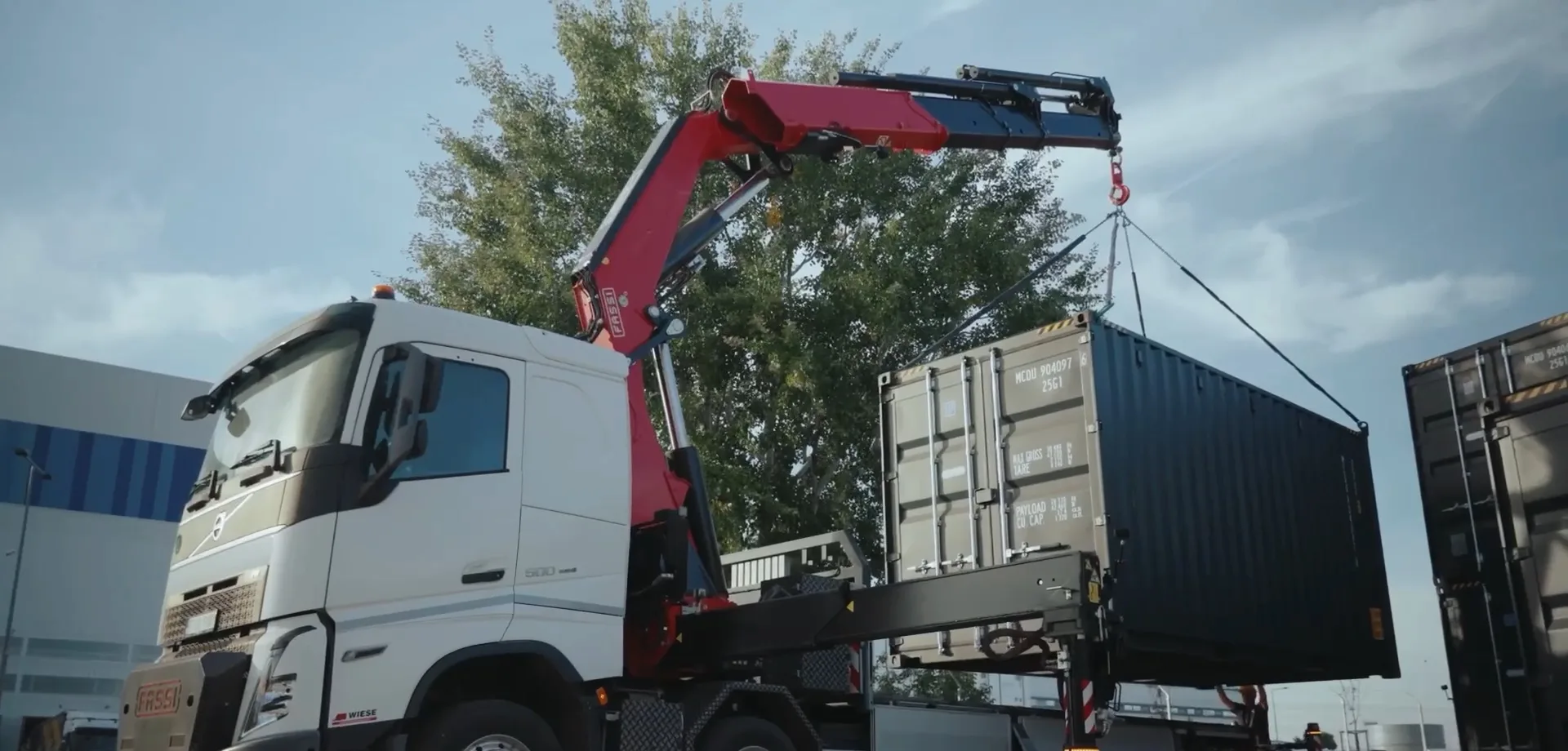
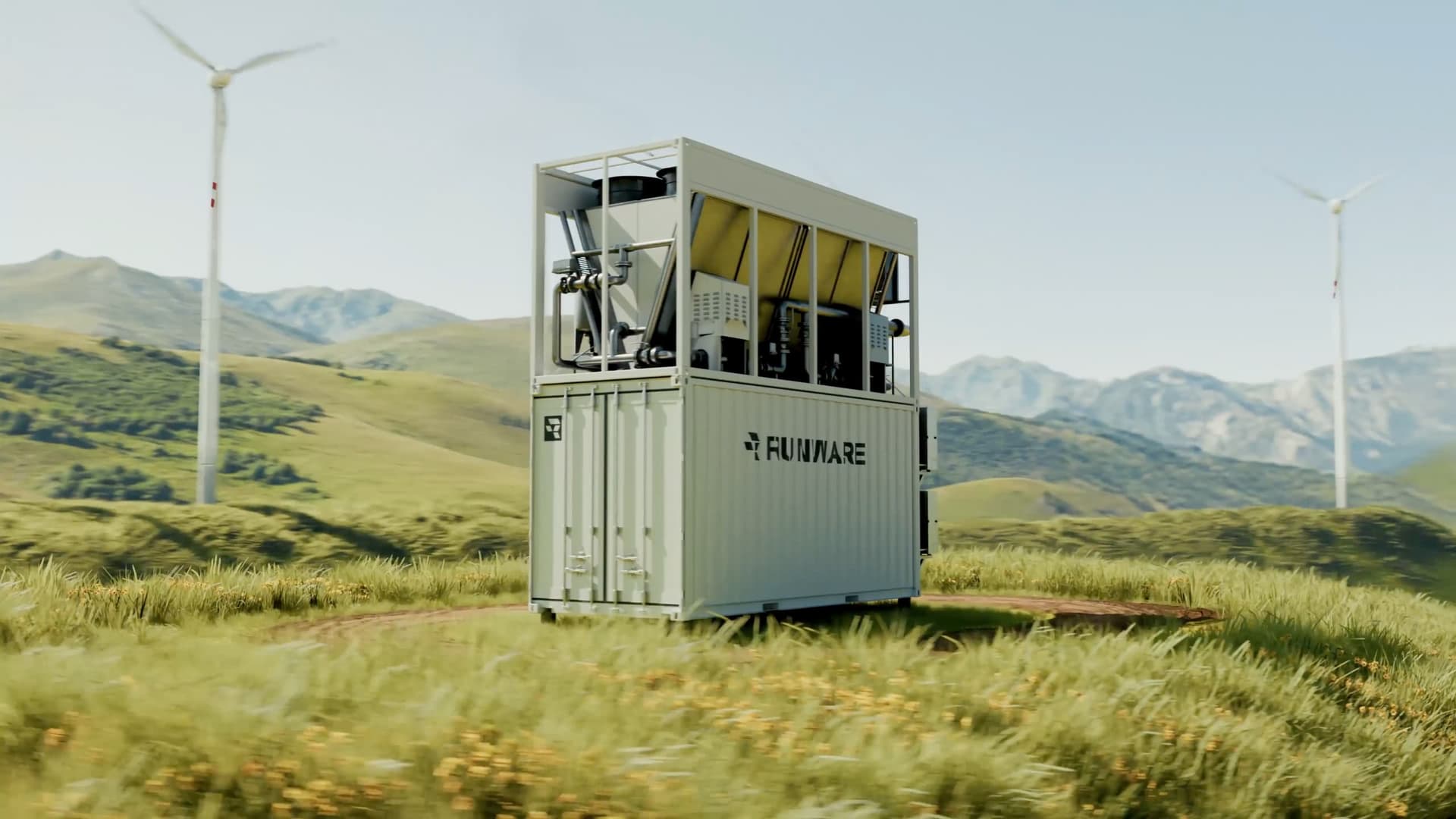
On October 30, we announced a modular AI data center factory that will build 10 gigawatts of AI compute capacity a year. It turns the data center from a construction project into a manufactured product: complete Sonic Pods come off a single production line, like cars, at up to 30 megawatts of capacity a day.
Each Sonic Pod is a whole data center in a shipping container, with 1 megawatt in a 20-foot container or 2 megawatts in a 40-foot one. The cooling loops, power electronics, circuit boards, and network switches are designed and built in-house, and every pod is tested at full load before it ships. At a site that already has power, a pod goes from delivery to first token in 48 hours.
The line is configurable across NVIDIA's range, from RTX PRO 6000 for high-volume inference to GB300 and Vera Rubin, including NVIDIA's new DSX POD reference design. Production starts in Europe in the first quarter of 2027 and reaches the full 10-gigawatt rate by the end of that year.
The factory will also expand the infrastructure behind Runware's own inference platform. Read the announcement, see the factory page, or reserve capacity.
Runware Serverless
On October 2, we launched Runware Serverless. It runs your own models, code, or containers on the GPU infrastructure behind Runware's Model APIs, including our own Sonic Pods, while we take care of the queues, scaling, and monitoring. Workers run on 1, 2, 4, or 8 GPUs and can scale to zero when they're idle.
$0
while idle
From
$1.60
per GPU-hour, on demand
From
$0.63
per GPU-hour, reserved
On-demand GPUs are billed by the second. The launch post covers how it works and what you can run on it.
Since the launch, Serverless has added:
- Multi-GPU checkpointing. GPU checkpointing now covers workloads that span several GPUs. A worker restores an already-initialized workload instead of repeating the expensive startup on every GPU, which cuts cold-start time for larger models and distributed inference.
- Environments. Keep development, staging, and production workloads apart, each with its own deployments and configuration, so you can test a change without touching production.
- OIDC connectors. Connect workloads to external services with OpenID Connect. A workload trades its trusted identity for short-lived credentials, so your deployments hold fewer long-lived secrets.
- Secrets templates. Set up secrets from a template and reuse the same configuration across deployments, with sensitive values kept out of your application code.
- Faster cold starts. The time from a request to a workload that's ready to run is down by about 4 seconds on average.
- One-click getting started. A shorter path from finding Serverless to deploying your first GPU workload.
Kling VIDEO 4.0
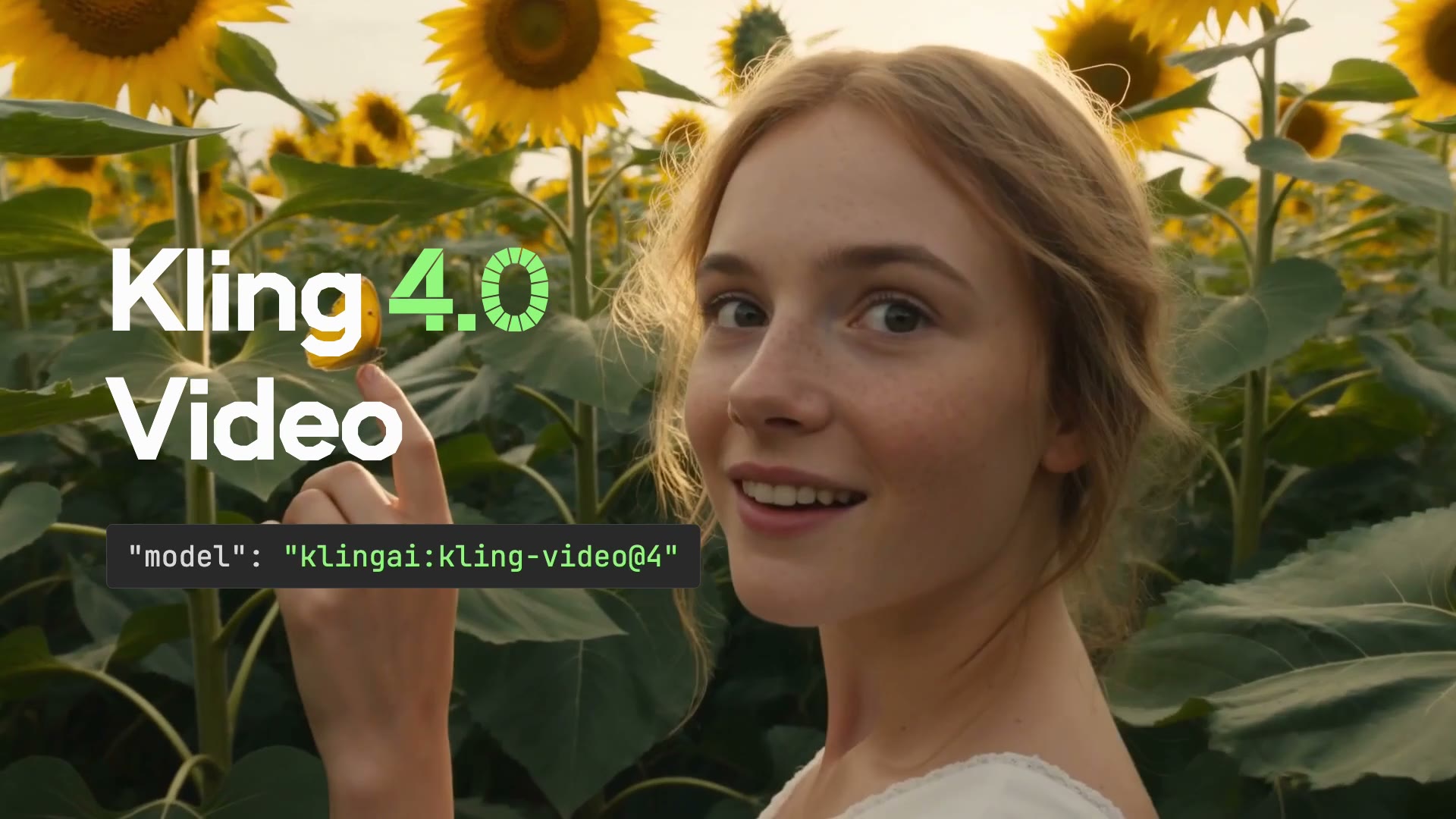
Kling VIDEO 4.0 is Kling's new flagship, and it puts everything in one model. Kling 3.0 came as separate Standard, Pro, Omni, and Turbo models; 4.0 covers text-to-video, image-to-video, reference-driven generation, and editing an existing video from a prompt.
It generates 1080p clips of up to 30 seconds and follows up to 10 keyframes per clip, including first, middle, and last frames. One request can combine reference images, reference videos, and reusable elements to keep subjects, style, and motion consistent. That makes it a strong fit for longer narrative shots, storyboard-driven sequences, and production work where a character or product has to look the same from shot to shot.
On Runware, Kling VIDEO 4.0 costs $0.157 per second at 720p and $0.235 per second at 1080p, so a 10-second 1080p clip is $2.35. With a video input, it's $0.188 per second at 720p and $0.282 at 1080p. See it in action on the Kling VIDEO 4.0 page.
klingai:kling-video@4.0Text-to-video, image-to-video, references, and video editing in one model. From $0.157 per second.
FLUX 3 Image and FLUX 3 Image Klein
- Face

- Outfit

- Snowcat
- Motorcycle

- Samoyed

- Research station

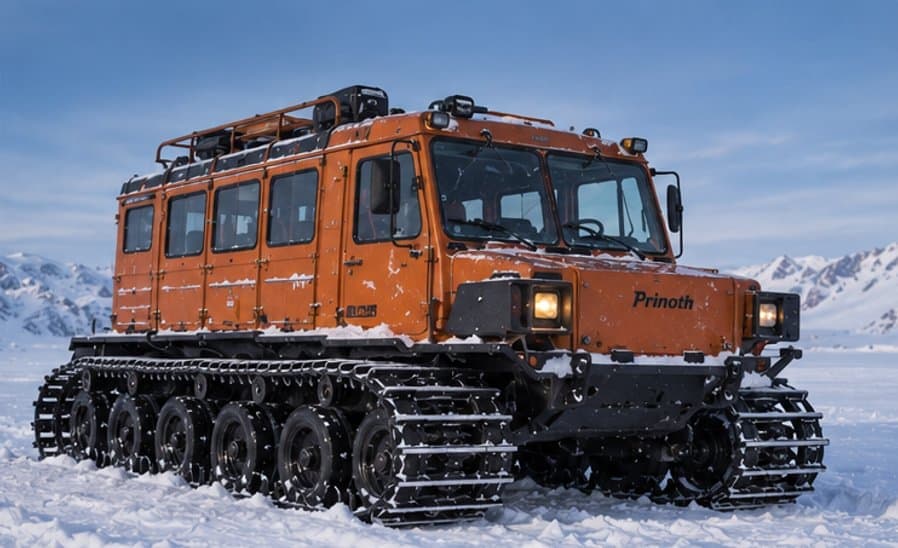
Black Forest Labs opened the month with FLUX 3 Image, its first image model built on the multimodal FLUX 3 backbone it shares with FLUX 3 Video. It generates natively at up to 4K, composes from up to 10 reference images while keeping identities and fine details, places elements with bounding boxes, and edits text in place, with accurate typography in text-heavy layouts. Pricing is flat across text-to-image and editing, and only the resolution changes it: $0.041 per image at 0.75K, $0.048 at 1K, $0.10 at 2K, and $0.607 at 4K.
Two weeks later, BFL released the open weights. FLUX 3 Image Klein is the distilled checkpoint, built for speed, and FLUX 3 Image Klein Base is the full undistilled model to fine-tune and customize. Both handle text-to-image and reference-based editing. Klein is the one for interactive apps, rapid iteration, and high-volume jobs: a 1024×1024 image at 16 steps costs $0.006.
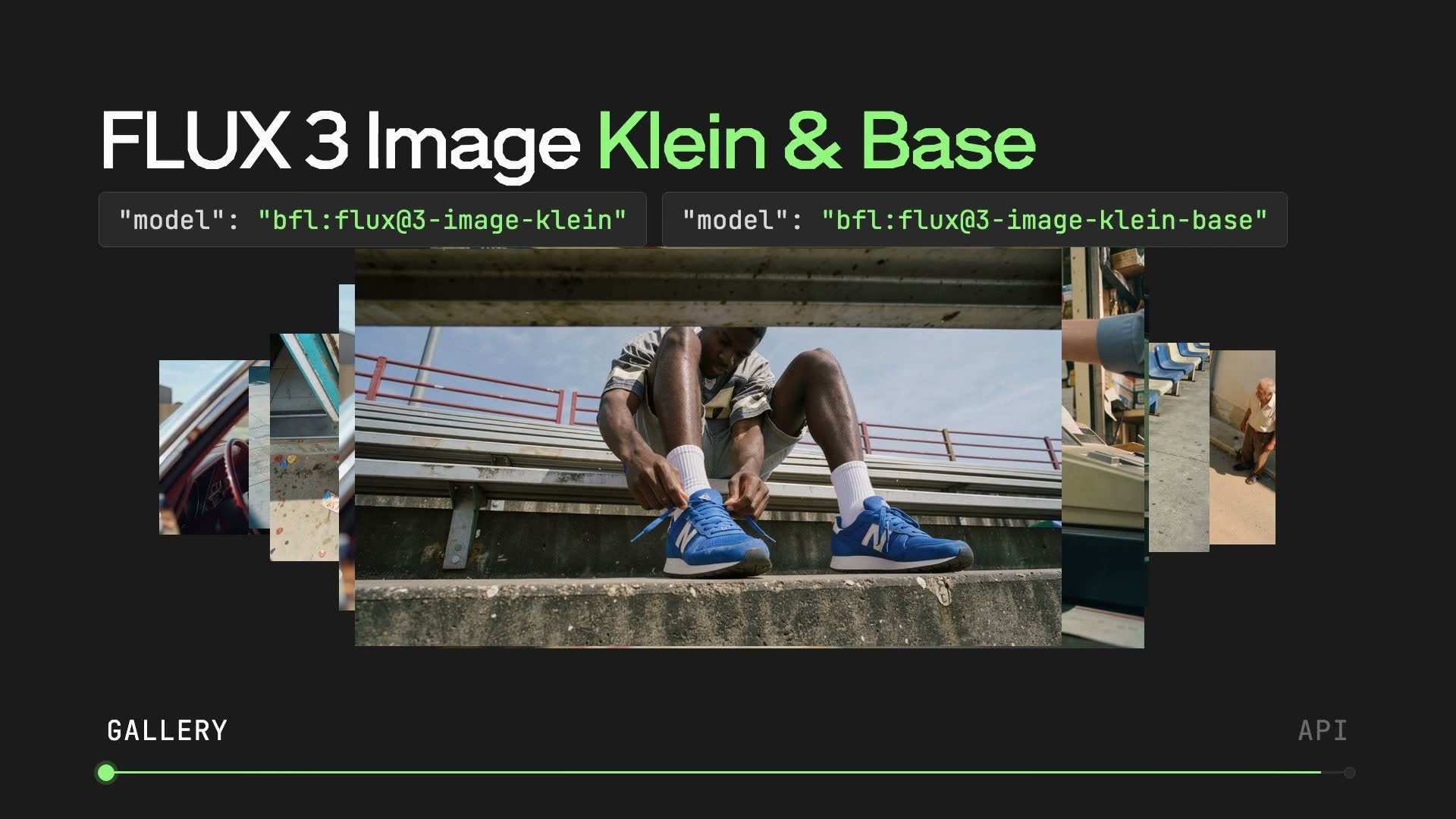
For four generations of FLUX side by side, read From FLUX.1 [dev] to FLUX 3 Image, or see more examples on the FLUX 3 Image page.
bfl:flux@3-imageNative 4K generation and editing with multi-reference control. From $0.041 per image.
bfl:flux@3-image-kleinThe distilled open-weights model, built for speed. $0.006 for a 1024×1024 image at 16 steps.
bfl:flux@3-image-klein-baseThe full undistilled open-weights model, for fine-tuning and research. $0.0238 for a 1024×1024 image at 50 steps.
Nano Banana 2.1
- Face

- Smock
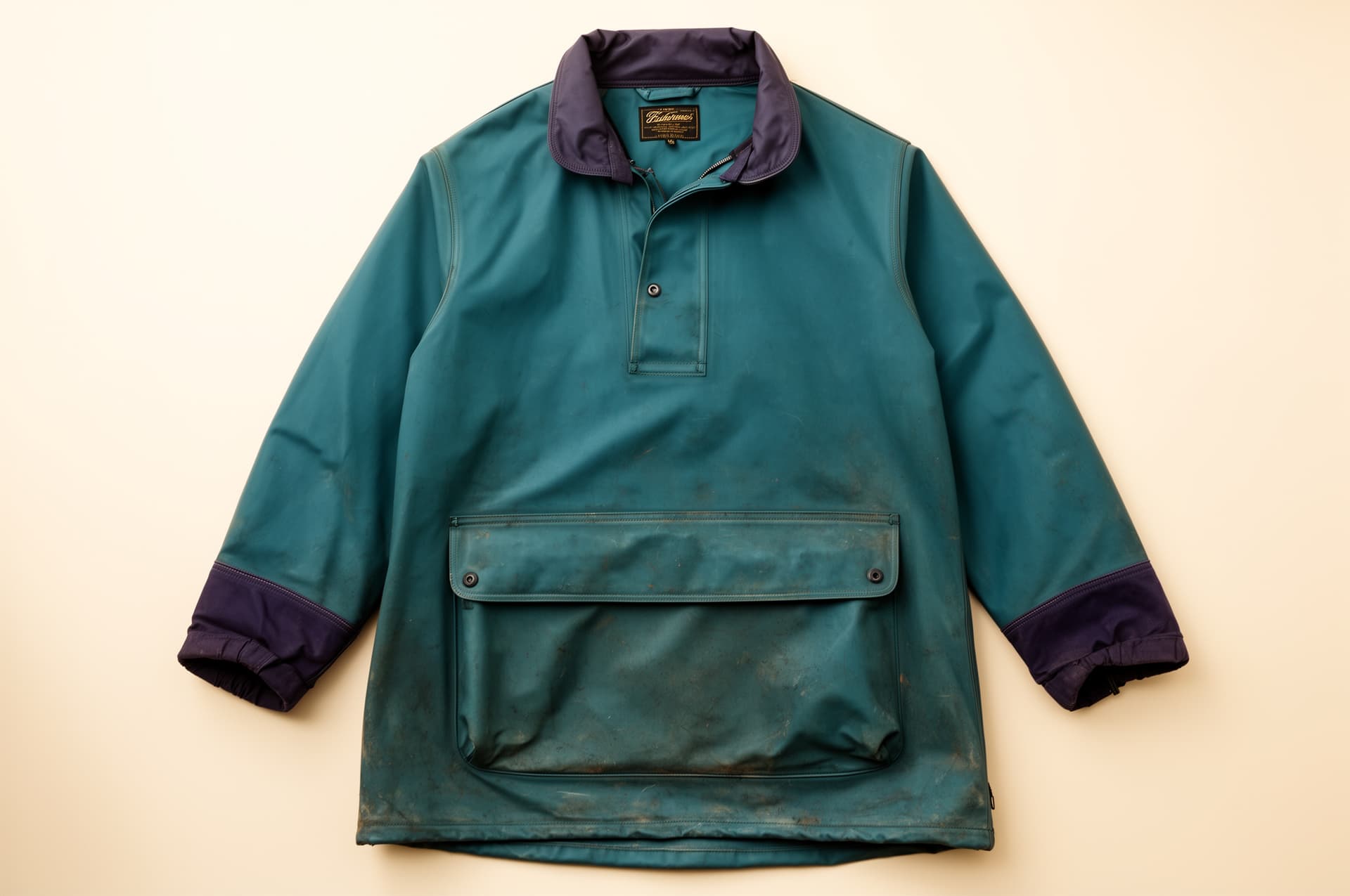
Google's update to Nano Banana 2 improves graphic composition and subject consistency, and follows complex prompts and edit instructions more closely. It works from text alone or from up to 14 reference images plus a reference video. It can also ground a generation in live web and image search, so the result reflects current facts and real visual references.
It renders at 1K, 2K, and 4K, with three thinking levels that trade speed for reasoning depth. That suits layout-heavy design work, recurring characters and products, and precise multi-step edits.
Nano Banana 2.1 is billed by tokens. In our test runs, a 1K image came to about $0.034 and a 2K image to about $0.052, roughly half of Nano Banana 2's $0.069 at 1K and $0.103 at 2K.
google:nano-banana@2.1Image generation and editing with multi-reference input and search grounding. Billed by tokens.
Also new this month
Image
alibaba:qwen-image@2.1-proAlibaba's image generation and multi-reference editing, with LLM prompt rewriting. $0.075 per image.
alibaba:qwen-image@2.1-turboThe lower-cost tier of the same family, at about a fifth of the Pro price. $0.0141 per image.
bria:20@1Structured-prompt image generation from 5:1 to 1:5, up to 4 megapixels. Replaces FIBO. $0.04 per image.
bria:21@1Instruction-based editing with masks and up to four reference images. Replaces FIBO Edit. $0.04 per image.
ideogram:vector@1.0Editable SVG artwork from a prompt, or from an existing image. From $0.10 per image.
Video
xai:grok-imagine@video-1.5-liteThe lower-cost tier of Grok Imagine Video 1.5, with native audio and clips up to 15 seconds. From $0.02 per second.
prunaai:p-video@2-pro-avatarLip-synced talking video from one portrait and an audio track or script, up to 3 minutes and 4K. From $0.02 per second.
prunaai:p-video@upscaleVideo upscaling to 720p, 1080p, 2K, or 4K that keeps the aspect ratio and audio. From $0.01 per second.
bfl:flux@video-upscaleBlack Forest Labs' video upscaler, with precise and creative modes. From $0.15 per second.
Audio
heygen:voice@1.0Text-to-speech with public voices and instant voice cloning from a single recording. $0.03 per 1,000 characters.
heygen:voice@1.0-turboThe faster version, with the same voices and cloning. $0.004 per 1,000 characters.
heygen:voice@1.0-turbo-freeTurbo on shared capacity, free to use for tests and prototypes.
Text and LLMs
These models run through Runware's OpenAI-compatible API.
openai:gpt@6.1-terraOpenAI's fast, efficient model for visual reasoning, computer use, and high-volume work. $1 / $5 per million input / output tokens.
google:gemini@4-argonGoogle's frontier model for long-horizon coding and knowledge work. $2 / $10 per million tokens through Nov 30, then $4 / $20.
anthropic:claude@haiku-5.5The fastest, lowest-cost Claude, for high-volume agents and extraction. $0.10 / $0.50 per million tokens.
deepseek:v4.1@flash-1017A multimodal 1M-context checkpoint for coding, reasoning, and tool use. $0.15 / $0.60 per million tokens.
minimax:m3.1@flashAn efficient open-weight multimodal model with a 1M-token context. $0.15 / $0.60 per million tokens.
Decision models
Jev 1.14 runs on /v1/decisions, which takes TypeSafe's decisions format, rather than the OpenAI-compatible API. For what decision models are for, read Jev, Laya, and the emerging role of decision models.
typesafe:jev@1.14TypeSafe's decision model for typed choice, score, and yes-or-no answers with a confidence level, over up to 262,144 tokens of context. $0.042 per million input tokens.
Tools
runware:ffmpeg@0The first tool in the new tools task type. Runs one FFmpeg command over up to 10 input files of up to 5 GB each, and returns a single video, audio, or image file. $0.02 per gigabyte-second.
Model updates
New features for models that were already on Runware.
- LTX-2.3: video extension. Add 2 to 20 seconds to the start or end of an existing clip.
- HeyGen Video 1.0: 1080p and 2K. Two new resolution tiers, in 16:9 and 9:16.
- MiniMax H3 Fast: 768p. A new tier alongside 480p, in the same six aspect ratios.
- P-Video-2-Pro: reference inputs. Generate from up to 9 reference images, 3 videos, and 3 audio tracks, alongside text and first and last frames.
- Ideogram 4.5 Precise Edit: region edits. Limit an edit to one region of the source, so images over 4 megapixels keep their full resolution.
Platform updates
- Long sync requests no longer time out. A task in a sync request over HTTP that's still running after 120 seconds now continues as an async task and returns
status: processinginstead of a timeout error. Poll with the sametaskUUIDfor the result. The TypeScript and Python SDKs do this for you from version 1.8.1. Video tasks now accept"deliveryMethod": "sync"too.
Every change, with the parameters, is in the changelog.
Deprecations and migrations
Switch before a model's removal date. After it, requests to that model return an error. gpt-oss-120b and Kimi K2.6 were removed on October 30.
| Model | Removal date | Switch to |
|---|---|---|
gpt-oss-120b (openai:gpt-oss@120b) | Removed October 30, 2026 | DeepSeek-V4.1-Flash (deepseek:v4.1@flash) or Gemma 4 31B (google:gemma@4-31b) |
Kimi K2.6 (moonshotai:kimi@k2.6) | Removed October 30, 2026 | Kimi K3 (moonshotai:kimi@k3) |
Gemini 3.7 Flash (google:gemini@3.7-flash) | November 12, 2026 | Gemini 3.8 Flash (google:gemini@3.8-flash), which already answers its requests |
Gemini 3.1 Flash TTS (google:gemini@3.1-flash-tts) | November 17, 2026 | No direct replacement yet |
GPT-5 Mini (openai:gpt@5-mini) | December 11, 2026 | GPT-5.4 Mini (openai:gpt@5.4-mini) |
GPT-5 Nano (openai:gpt@5-nano) | December 11, 2026 | GPT-5.4 Nano (openai:gpt@5.4-nano) |
From the blog

Written by
Ally Nicoll
Developer Advocate at Runware
Ally Nicoll is a Developer Advocate at Runware, where he helps developers and creators understand and build with Runware's AI infrastructure. He focuses on developer education, product communication, model launches, and practical AI workflows, translating technical capabilities into clear, useful guidance.
More posts by Ally NicollTry October's new models on Runware.
Every model in this roundup is live on Runware, from image and video to audio and LLMs.
Open the PlaygroundKeep reading

Runware unveils AI factory to build modular AI data centers just like cars
Runware's new European factory will build complete, AI-native data centers on an assembly line: 1MW and 2MW Sonic Pods, up to 30MW a day, 10GW a year, from Q1 2027.