MiniMax H3 Image
Request
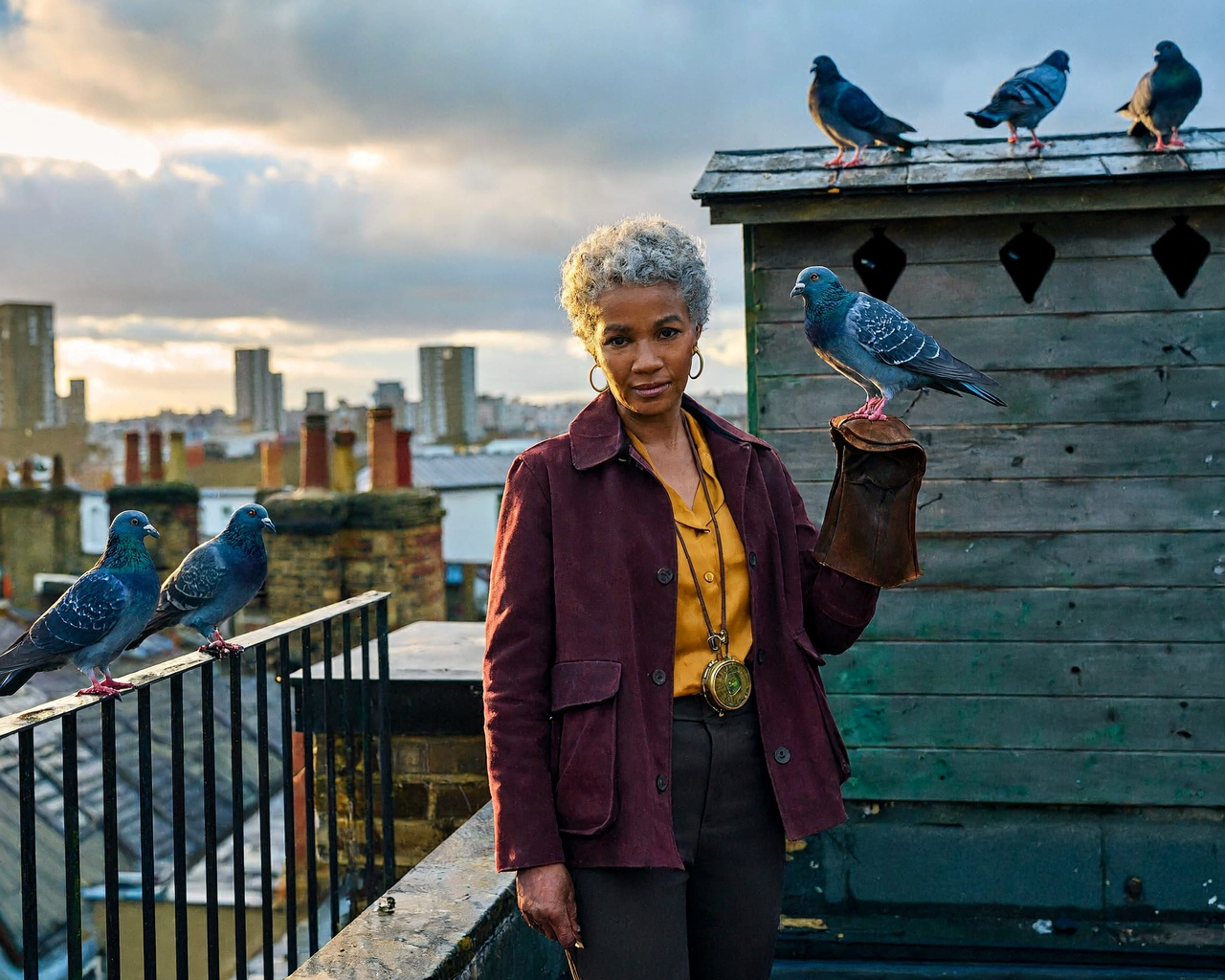
Create a finished landscape editorial photoshoot portrait of one championship pigeon racer on the rooftop of her urban pigeon loft. Compose her three-quarter length in the center-right of the frame, looking directly into the camera with quiet confidence. She is a stylish British-Caribbean woman in her late 50s with short silver curls, a weathered burgundy waxed field jacket, mustard silk blouse, tailored charcoal trousers, fine gold hoop earrings, and a vintage brass racing timer hanging from a narrow leather strap. Her left forearm is raised in a thick falconry-style glove. Include exactly six pigeons in the entire image, all fully visible and clearly separated: one blue-bar racing pigeon perched on her raised glove; two pigeons spaced apart on the rooftop railing at far left; and three pigeons spaced apart along the pitched roof of the wooden loft at upper right. No other birds anywhere, including in the sky, shadows, reflections, background, or decorative imagery. The loft has small geometric entry openings, but no birds inside them. Keep the woman's face and all six pigeons sharply legible. Frame the scene as a sophisticated personal profile photograph with useful negative space in the upper-left sky for optional editorial cropping, but include no typography, captions, logos, borders, or watermarks. Show a dense London roofline softly out of focus behind her, with chimney pots, old brick, and distant apartment towers. Use a low eye-level camera angle and natural 55mm portrait perspective, realistic anatomy, authentic fabric texture, detailed feathers, and restrained depth of field. Art direction: contemporary British sporting portrait with subtle 1970s editorial character. Palette of burgundy, mustard, weathered teal, slate blue, warm brick, and silver gray. Late-afternoon sunlight breaks through after rain, creating a warm rim light around her hair and the pigeons while cool storm clouds remain in the distance. Slightly damp rooftop surfaces catch soft reflections. Mood is dignified, resilient, intimate, and quietly triumphant rather than whimsical. Photorealistic high-end magazine photography, fine natural grain, nuanced skin texture, controlled contrast, polished color grade.
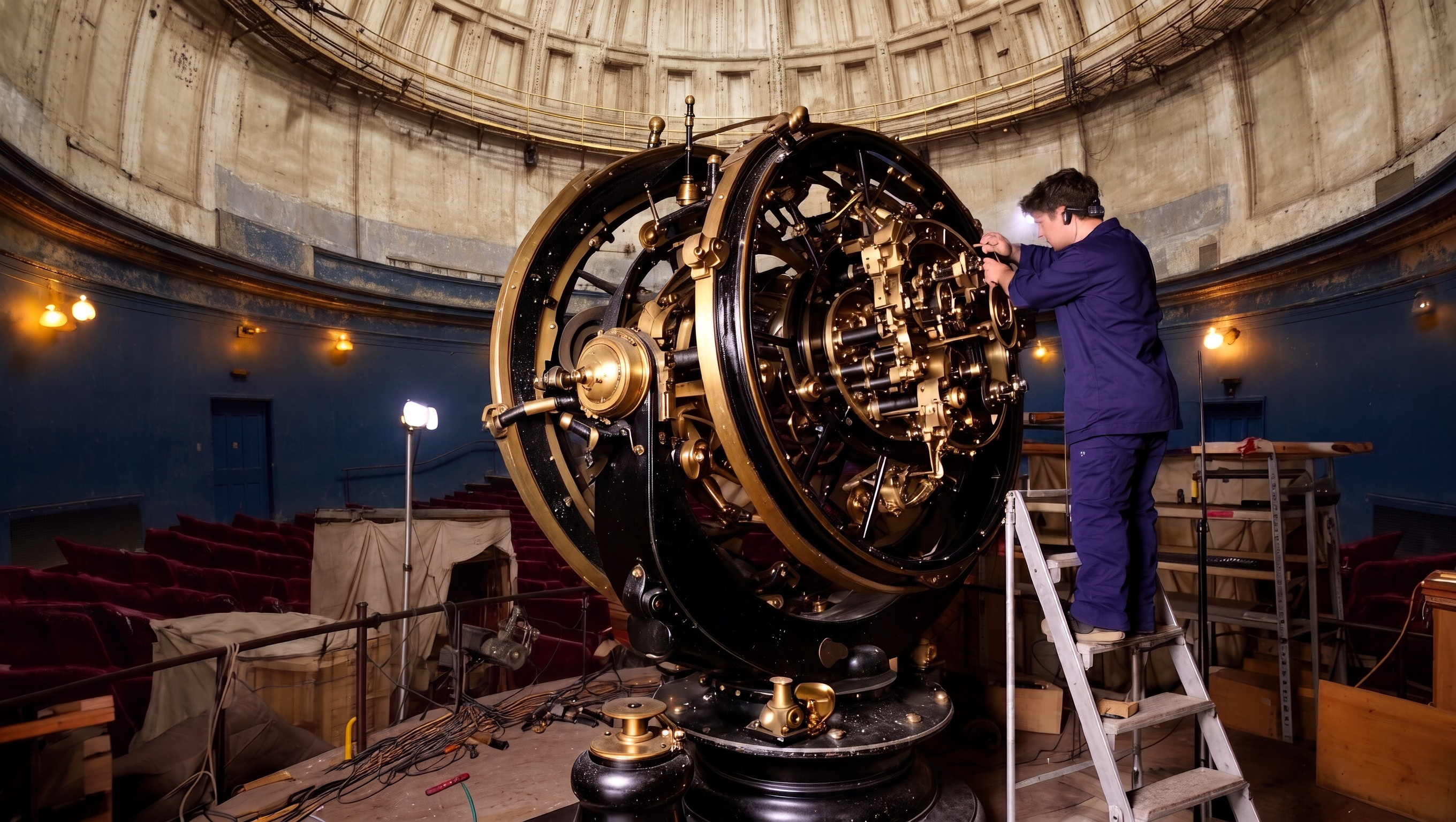
Create a seamless 16:9 outpaint for a museum fundraising campaign banner. Use image 1 as the immutable central source photograph: preserve its antique Zeiss star projector, conservator, pose, clothing, scaffold, tools, lighting, perspective, proportions, surface details and central framing unchanged. Do not redesign, duplicate, move or crop the projector or conservator. Extend the photograph naturally beyond image 1 on the left and right, with no visible borders, seams or change in photographic texture. Use image 2 as the architectural and color reference for the newly revealed surroundings: continue the ribbed plaster dome, maintenance catwalk, curved rows of faded oxblood seats, dark blue walls, amber aisle lamps and authentic age patina. Keep image 2's distinctive ceiling-rib geometry, seat color, indigo-brass-burgundy palette and historic material character unchanged while adapting its perspective to connect convincingly with image 1. The expanded sides should reveal more of the auditorium without adding another person or another projector. Maintain consistent lens perspective, grain, depth of field, shadow direction and practical work-light illumination across the complete panorama. Compose with the original restoration activity near the center and generous environmental context on both sides, suitable for a 2K museum campaign hero image. Cinematic documentary realism, restrained and dignified mood, historically credible conservation workspace. No lettering, logo, border, collage, split screen or interface.
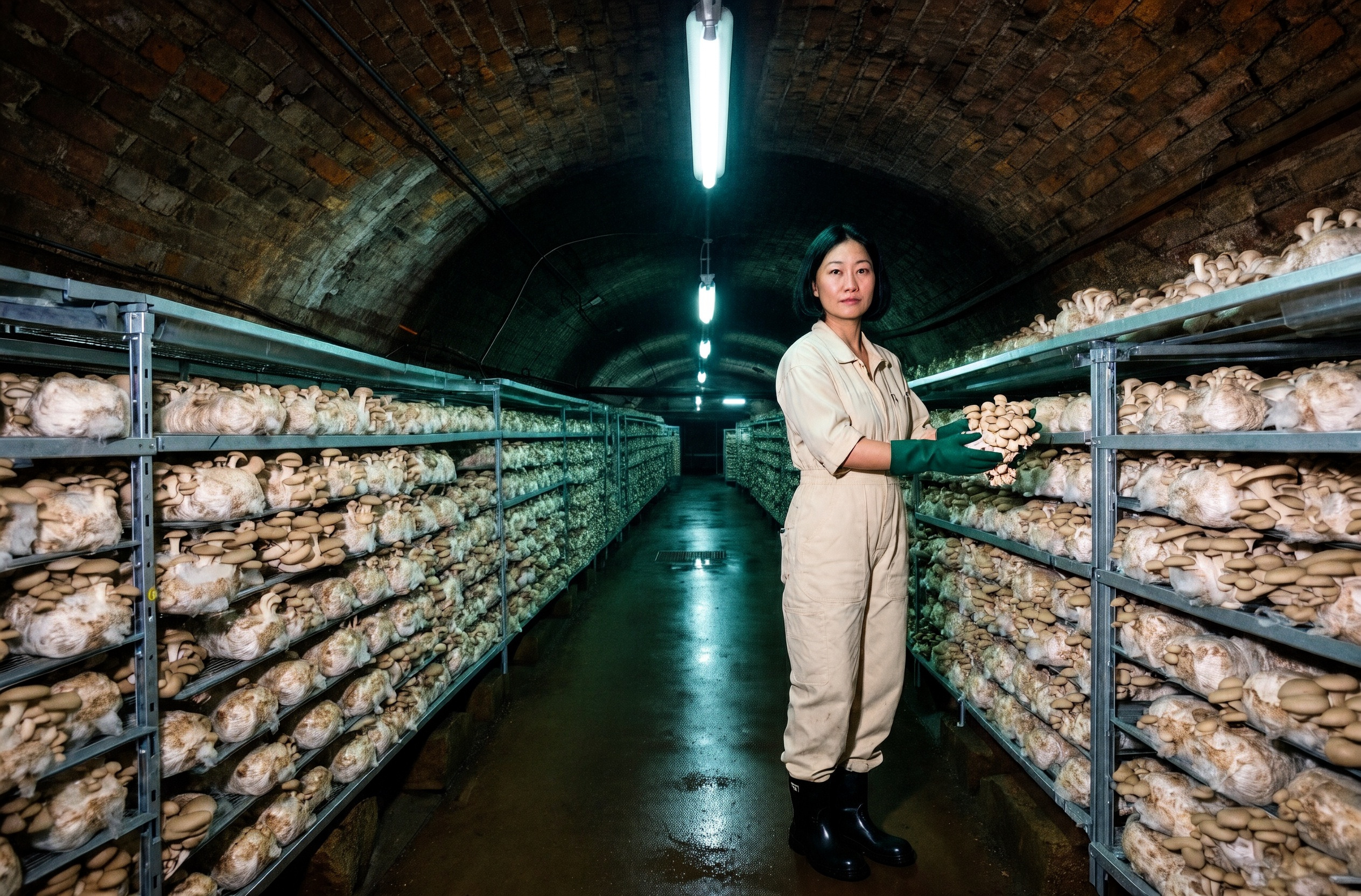
Create a finished horizontal editorial magazine photograph for the opening spread of a serious feature about subterranean urban agriculture. Use image 1 as the subject reference: place the mushroom grower from image 1 inside the farm, preserving her facial identity, age, skin tone, short black bob, cream utility coveralls, dark green rubber gloves, and black work boots unchanged. She stands slightly right of center beside a waist-high rack, one gloved hand gently supporting a cluster of oyster mushrooms while looking directly into the camera with quiet confidence. Use image 2 as the location and visual palette reference: preserve the tunnel's damp brick arches, galvanized rack geometry, oyster mushroom grow bags, fluorescent fixtures, wet concrete floor, cool blue-green ambient color, and deep receding perspective unchanged. Integrate the subject naturally at the correct scale with convincing contact shadows and reflected light. Photograph from waist height with a 40mm medium-format documentary look, environmental portrait framing, crisp eyes and tactile detail in the mushrooms, brick, condensation, fabric, and gloves. Mix the existing cool fluorescent ambience with restrained direct on-camera flash for a contemporary editorial aesthetic: honest, slightly stark, sophisticated, and unsentimental. Keep generous darker negative space in the upper-left area for an editor to place a headline later, but generate no typography, captions, logos, borders, watermark, or magazine mockup. Photorealistic color photography, natural anatomy, realistic skin texture, subtle film grain, controlled highlights, 2K-ready detail.
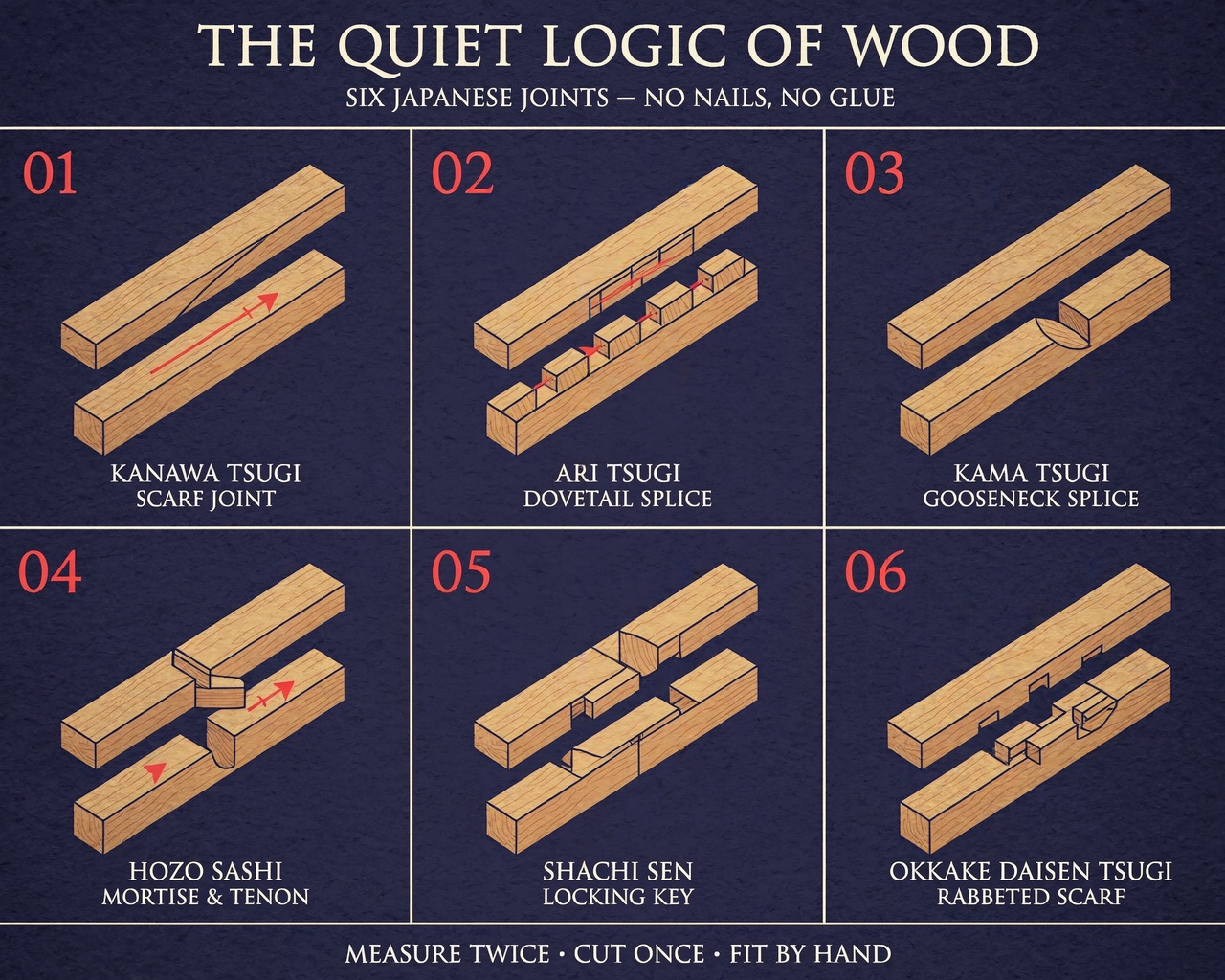
Create a finished landscape wall-art print, not a framed mockup and not a photograph of a poster. Design a clear educational chart about traditional Japanese timber joinery. Use a strict 5:4 landscape composition with a wide title band across the top, six joint diagrams arranged in an exact 3-column by 2-row grid, and a narrow footer band. Leave generous margins and consistent spacing. At the top center, set the main title exactly as "THE QUIET LOGIC OF WOOD" in large uppercase lettering. Directly beneath it, set the subtitle exactly as "SIX JAPANESE JOINTS — NO NAILS, NO GLUE" in smaller uppercase lettering. Show exactly six distinct exploded isometric timber-joint diagrams, one per grid cell. Each diagram consists of two warm cedar components separated slightly to reveal how they interlock, with crisp black construction lines and small vermilion-red directional arrows. Number the diagrams with large red numerals in their upper-left corners and place two centered label lines beneath each illustration. Arrange and label them exactly as follows: Top left: "01" with "KANAWA TSUGI" and beneath it "SCARF JOINT". Top center: "02" with "ARI TSUGI" and beneath it "DOVETAIL SPLICE". Top right: "03" with "KAMA TSUGI" and beneath it "GOOSENECK SPLICE". Bottom left: "04" with "HOZO SASHI" and beneath it "MORTISE & TENON". Bottom center: "05" with "SHACHI SEN" and beneath it "LOCKING KEY". Bottom right: "06" with "OKKAKE DAISEN TSUGI" and beneath it "RABBETED SCARF". In the bottom center footer, write exactly "MEASURE TWICE • CUT ONCE • FIT BY HAND". Include no other words, letters, captions, logos, signatures, or watermarks. Art direction: refined Japanese technical print combining an Edo-period woodblock sensibility with a mid-century workshop diagram. Deep indigo background, warm honey-cedar wood grain, aged ivory typography, restrained vermilion accents, subtle fibrous washi-paper texture, slightly imperfect ink edges, clean geometric draftsmanship, elegant negative space, balanced visual hierarchy. The joints must remain mechanically plausible and easy to compare. Flat archival print appearance with gentle ink variation rather than glossy digital effects. Calm, disciplined, tactile, and suitable for premium print-on-demand wall art in a woodworker's studio.