Kling IMAGE 4.0
Request
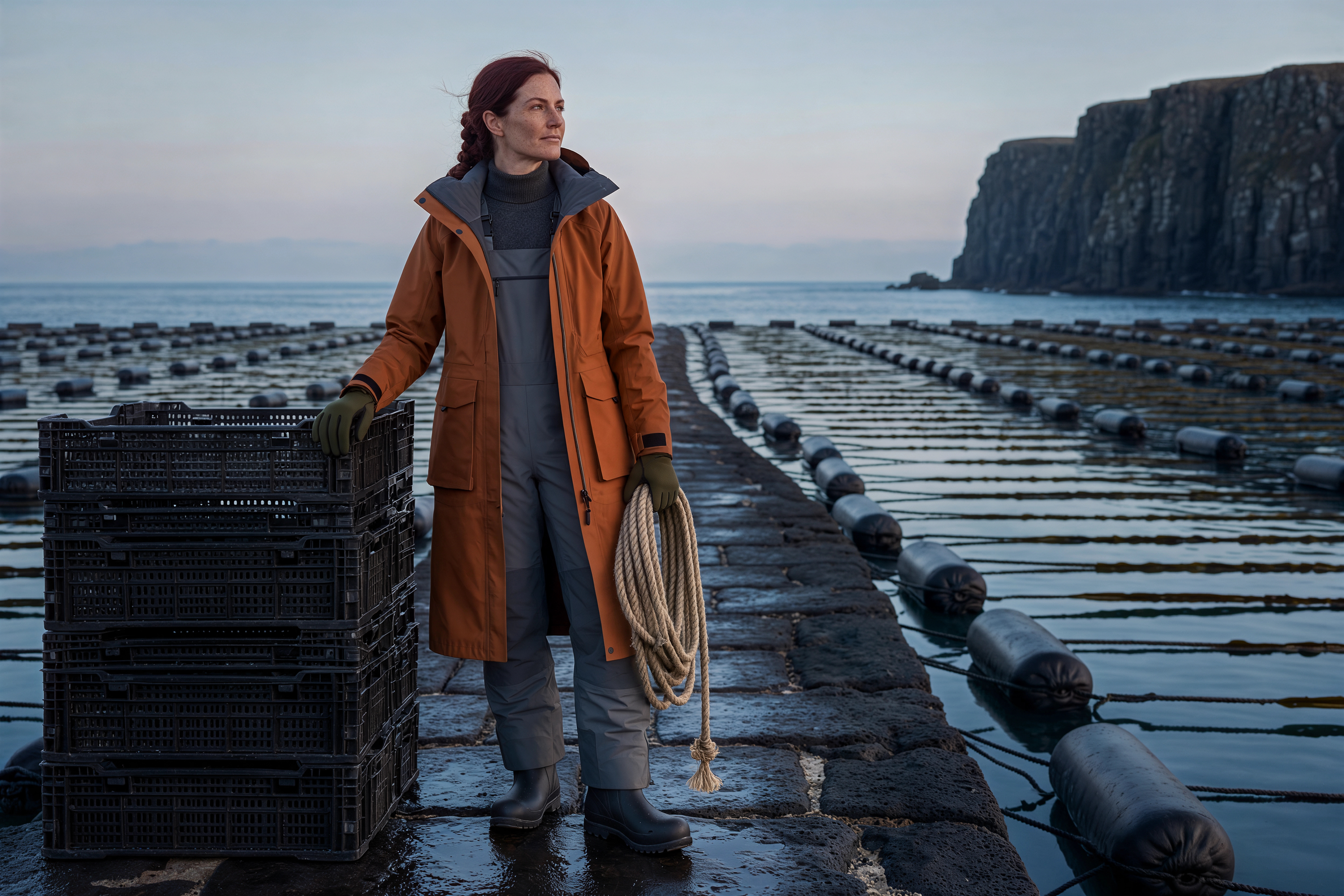
Create one coherent ordered four-image fashion lookbook sequence for a premium technical outerwear collection, photographed at a working seaweed farm on a rugged North Atlantic coast. Preserve the same main subject, outfit, setting, weather system, and restrained documentary-editorial style across all four images. The model is a woman in her early 40s with wind-reddened fair skin, faint freckles, a strong angular face, and dark auburn hair tied in one low practical braid. Her complete outfit remains identical throughout: a matte burnt-orange knee-length waterproof shell with a sculpted storm hood, concealed two-way zipper, black welded seams, large bellows pockets, adjustable cuffs, charcoal merino roll-neck, slate waterproof bib trousers, black rubber deck boots, and dark olive neoprene harvesting gloves. Garments must remain commercially legible, realistically constructed, cleanly proportioned, and consistent in color and detail. No visible brand marks, lettering, captions, borders, collage layouts, or duplicate people. Advance a clear visual narrative through four separate catalog photographs in this exact order: Image 1 — dawn arrival: a full-length front three-quarter fashion portrait on a narrow wet stone causeway leading into the tidal farm. The woman stands beside stacked black harvesting crates, hood down, carrying a coiled rope in one hand. Pale blue predawn sky, distant basalt cliffs, orderly seaweed lines receding behind her, calm purposeful expression. Show the complete silhouette and boots clearly, with generous negative space and an elevated but believable catalog composition. Image 2 — morning harvest: the same woman and unchanged outfit working knee-deep at low tide among parallel seaweed ropes, shown in a dynamic side profile as she lifts a long glossy ribbon of kelp. The coat is partially unzipped just enough to reveal the charcoal roll-neck and bib construction while retaining the same styling. Wind catches the coat hem and braid. Emphasize waterproof fabric behavior, wet surfaces, glove texture, seam construction, and practical mobility without making the pose theatrical. Image 3 — squall detail: the weather has intensified into slanting rain. Create a close three-quarter portrait from mid-thigh upward on the same tidal farm, with the storm hood now raised and cuffs tightened. The woman braces against the wind while securing a seaweed line; droplets bead naturally across the burnt-orange shell. Preserve her face and identity exactly. The background ropes, dark water, and cliffs soften through rain, while the hood geometry, welded seams, zipper guard, pockets, and gloves remain crisp enough for a fashion catalog. Image 4 — dusk return: a full-length rear three-quarter view transitioning into a subtle glance back toward camera as she walks along the same wet causeway carrying a filled harvesting basket. Hood lowered again, braid visible, outfit unchanged and fully recognizable. The storm breaks into a narrow band of cool silver light over the sea; puddles reflect the orange coat. End with a quiet, resilient mood and a clear view of the coat’s back vent, hem, trouser fit, and boots. Use natural overcast coastal light evolving plausibly from blue dawn through rain to silver dusk, cool mineral blues and charcoal grays offset by the single burnt-orange garment. High-end European workwear lookbook aesthetic, authentic marine agriculture, subtle analog color response, restrained contrast, fine skin texture, realistic wet technical fabrics, accurate hands and anatomy, editorial photography rather than cinematic fantasy. Vertical catalog framing, consistent lens language around 50mm with modest depth of field, camera-real detail, no artificial glamour retouching.
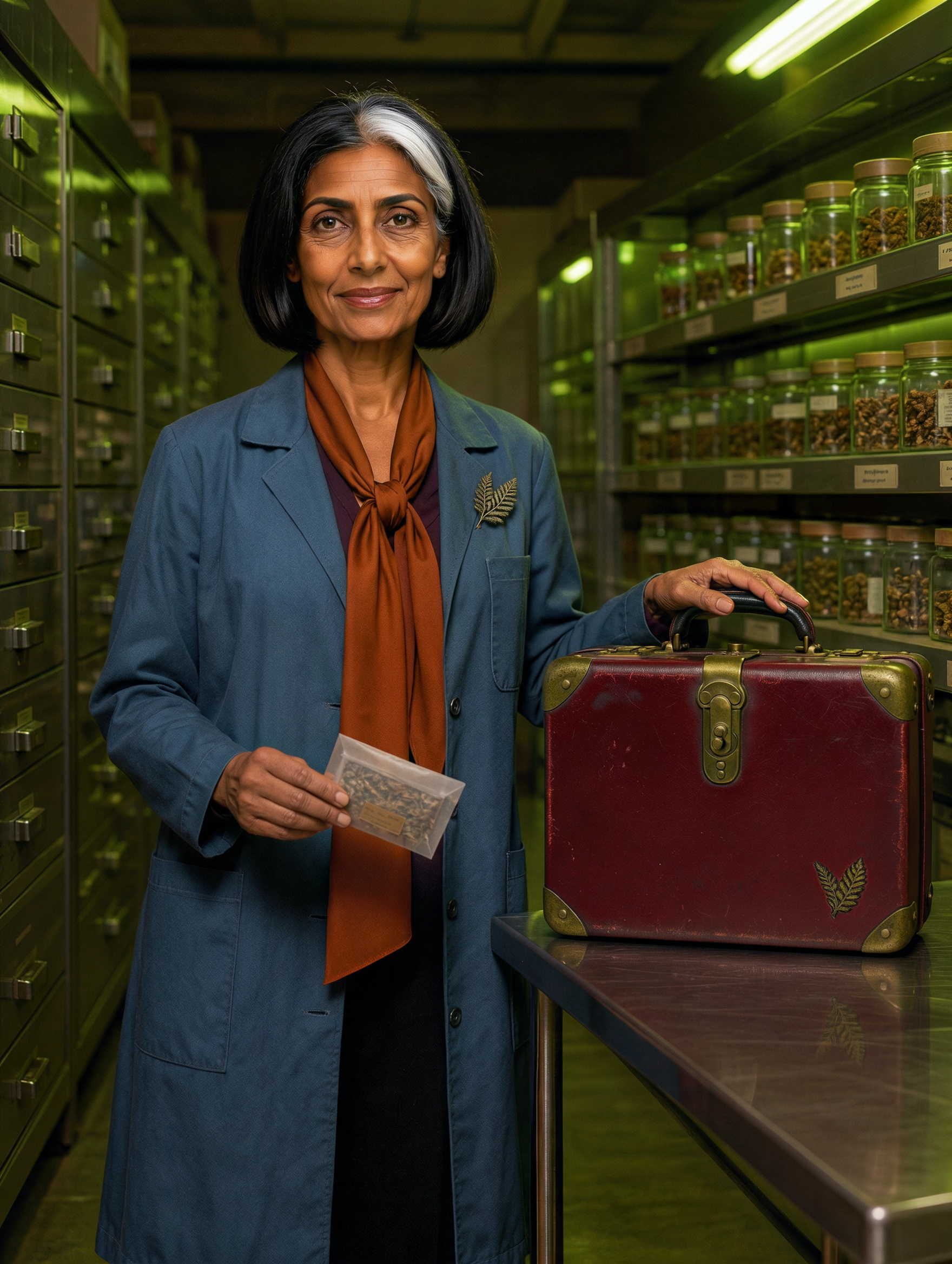
Create a finished vertical character campaign portrait for an after-hours botanical museum audio drama. Preserve the exact identity, age, facial structure, skin tone, silver-streaked bob and intelligent presence of <<<element_1>>>. Preserve the distinctive construction, oxblood leather, brass hardware, proportions and embossed fern emblem of <<<element_2>>>. Dr. Meera Voss stands alone in a restricted seed-bank evidence room at night, framed from just above the knees with her face in the upper third. She wears a sharply tailored petrol-blue laboratory coat over a dark plum blouse, a narrow burnt-orange silk scarf, and a small antique brass fern brooch. One hand rests protectively on the closed herbarium case placed upright on a stainless-steel examination table beside her; the other hand holds a single translucent seed envelope at waist level. Her posture is composed and authoritative, with a restrained, knowing expression and direct eye contact, presenting her as the unmistakable recurring lead character rather than a generic scientist. Art direction: sophisticated 1980s European science-magazine editorial portrait reinterpreted with contemporary cinematic realism. Hard direct flash defines the subject and creates a crisp shadow, while dim chartreuse fluorescent practical lights recede through rows of steel specimen cabinets and glass seed jars. Controlled palette of petrol blue, oxblood red, nicotine cream, dark plum and acidic chartreuse. Fine 35mm color-negative grain, subtle halation around practical lights, natural mature skin texture, realistic hair strands, precise fabric weave, convincing worn leather and tarnished brass. Slightly low camera position, 50mm lens character, clean graphic silhouette, shallow but readable background depth. Quietly tense, cerebral and elegant mood suitable for museum posters, press materials and episode artwork. No lettering, logos, captions, borders, interface elements or additional people.
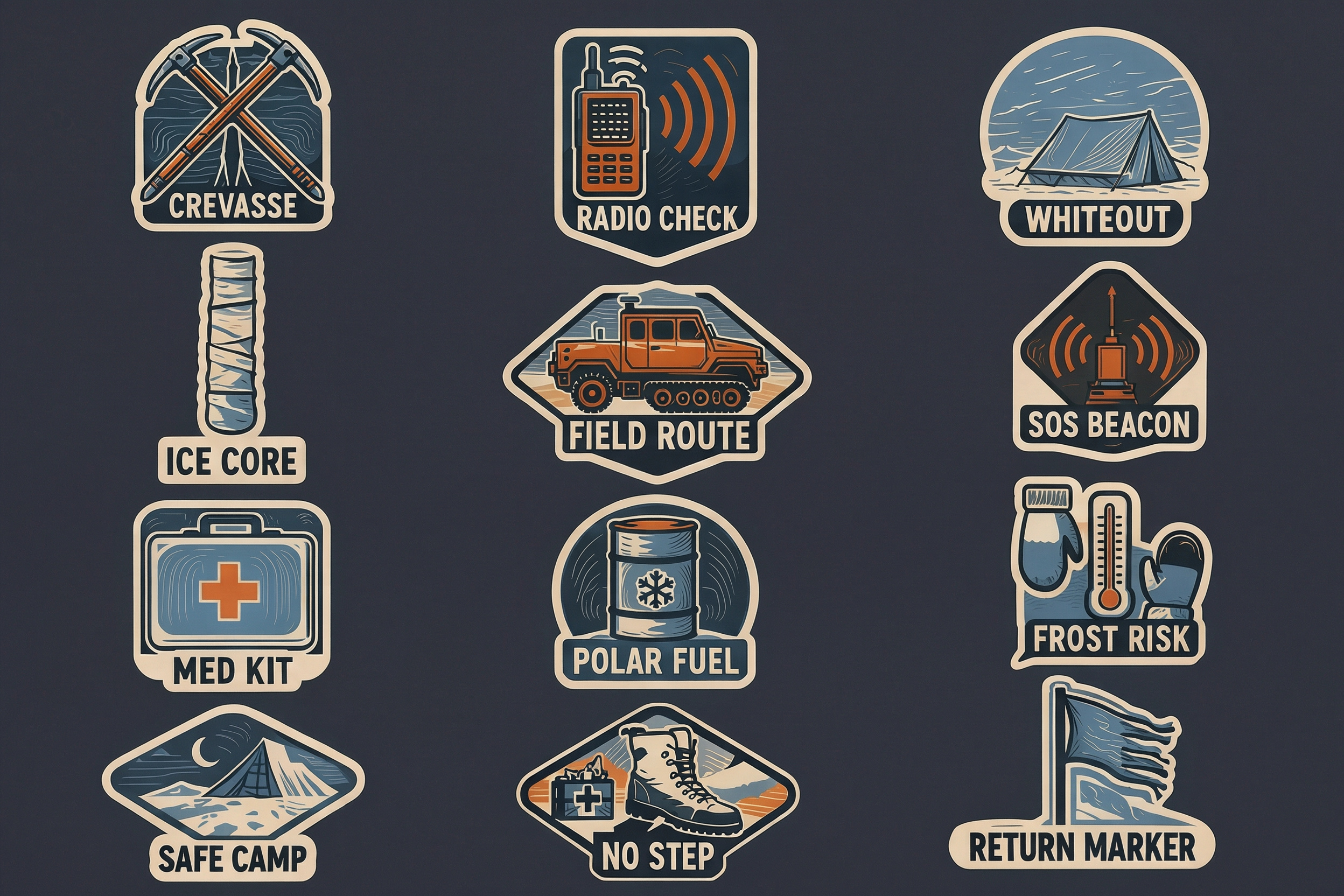
Create a finished landscape presentation of twelve die-cut safety stickers commissioned for an Antarctic research expedition. Arrange the complete sticker pack in a clean 4-by-3 grid on a flat deep-charcoal background, evenly spaced with generous margins, every sticker fully visible and isolated, viewed perfectly straight-on. This is the final sticker artwork, not packaging, not a website, and not a photograph of stickers attached to objects. The twelve distinct stickers are: 1) a crossed ice axe and crevasse probe with the exact label “CREVASSE”; 2) a handheld radio emitting three signal arcs with “RADIO CHECK”; 3) a wind-blown field tent beneath streaking snow with “WHITEOUT”; 4) an upright cylindrical ice core sample with “ICE CORE”; 5) a rugged tracked snow vehicle in side profile with “FIELD ROUTE”; 6) a satellite emergency beacon with “SOS BEACON”; 7) a medical case with a bold cross and “MED KIT”; 8) a fuel drum with one snowflake symbol and “POLAR FUEL”; 9) insulated gloves surrounding a thermometer with “FROST RISK”; 10) a compact emergency shelter beneath a crescent moon with “SAFE CAMP”; 11) a boot hovering above fragile scientific equipment with “NO STEP”; 12) a directional flag bending in severe wind with “RETURN MARKER”. Render every quoted label once, spelled exactly as written, in large condensed uppercase sans-serif lettering. Art direction: rugged 1970s expedition graphics updated with contemporary vector precision; bold screen-printed shapes, simplified technical pictograms, subtle engraved contour-line textures, crisp geometric construction, and strong instant readability from several meters away. Use a tightly controlled high-visibility palette of safety orange, glacier blue, warm ivory, and near-black. Give each sticker a different practical silhouette—rounded rectangle, shield, circle, capsule, diamond, and irregular badge—while maintaining one cohesive visual system. Add a substantial warm-ivory die-cut border around every sticker and a restrained flat offset shadow that separates it from the background. Keep all pictograms anatomically and mechanically credible, with no decorative fantasy imagery. Sharp clean edges, consistent line weights, balanced negative space, print-ready appearance, no gradients, no tiny illegible copy, no extra words, no logos, no brand names, no hands, no table, no rolls of vinyl, no interface elements, and no cropped stickers.

Design a polished, professional e-commerce product detail page around the exact acoustic water-leak listening rod shown in <<<image_1>>>. Preserve its distinctive construction, proportions, stainless-steel shaft, black diaphragm housing, grips, fittings, and probe tip consistently in every product view. The audience is municipal water departments, utilities, plumbing contractors, and facilities maintenance teams. Create one cohesive tall page with a restrained field-instrument art direction inspired by civil engineering manuals and premium outdoor equipment catalogs. Palette: limestone white, charcoal, muted safety orange, oxidized copper, and desaturated blueprint blue. Use a precise modular grid, generous whitespace, fine technical rules, clean sans-serif typography, subtle contour-map lines, and documentary photography. The tone is dependable, practical, quiet, and highly competent rather than futuristic or flashy. Begin with a strong hero section: a large, crisply lit three-quarter product portrait of <<<image_1>>> on warm off-white, with the exact headline “ACOUSTIC LEAK LISTENING ROD” and subheading “Pinpoint underground water noise before excavation.” Include a compact factual summary: “Mechanical listening instrument • No batteries required • Stainless-steel probe.” Do not invent a brand, logo, certification, price, discount, review score, or unsupported performance claim. Continue with clearly differentiated editorial sections: an in-use documentary scene showing a utility technician in practical high-visibility workwear placing the same rod against a curbside valve box on a calm early morning street; a three-step visual sequence titled “LISTEN • COMPARE • NARROW THE SOURCE”; a clean exploded technical illustration identifying “Acoustic diaphragm,” “Comfort grips,” “Stainless-steel shaft,” and “Hardened probe tip”; a close material-detail section with macro views of brushed steel, textured rubber, and machined fittings; a comparison diagram showing contact points at a hydrant, valve box, exposed pipe, and meter housing; a concise specifications table with neutral placeholder-safe labels rather than fabricated measurements: “Construction,” “Probe length,” “Grip material,” “Instrument weight,” and “Included items”; a maintenance panel titled “FIELD CARE” with the instructions “Wipe clean after use,” “Keep the diaphragm dry,” and “Inspect the probe tip regularly”; and a final package-contents image showing the listening rod and a simple protective canvas sleeve arranged neatly on a pale technical drafting surface. Render all displayed wording accurately and legibly. Keep the product dominant and easy to inspect. Use natural skin, realistic municipal infrastructure, believable scale, physically accurate reflections, and premium camera-like material detail. Maintain consistent product identity throughout. The output is the finished page artwork itself, not a browser screenshot or device mockup: no browser chrome, navigation bar, cursor, pop-up, shopping cart, form controls, or clickable call-to-action buttons.

Design one complete tall, long-form personal profile website for Dr. Anika Rao, a 56-year-old British Indian forensic botanist and expert witness. The site’s purpose is to establish her credibility for legal teams, museums, universities, and documentary producers while presenting a distinctive commissioned personal portrait photoshoot. Render the finished webpage itself as one uninterrupted vertical canvas, not inside a browser, laptop, phone, or presentation mockup. No browser chrome, cursor, app interface, conventional navigation bar, floating controls, or button-shaped calls to action. EVERY LINE OF TEXT VISIBLE ON THE PAGE MUST BE IN ENGLISH. Use only coherent English copy, with accurate spelling and no filler text, pseudo-writing, random symbols, Chinese characters, or duplicated phrases. Visual identity: rigorous botanical archivalism interpreted as contemporary editorial portraiture. Palette of near-black charcoal, dried fern green, oxidized copper, warm bone, and small accents of ultraviolet amber. Use an elegant high-contrast serif for headlines and a restrained modern sans serif for captions and technical information. Strong typographic hierarchy, generous negative space, thin specimen-rule lines, subtle paper grain, tiny accession-number motifs, and translucent overlays inspired by microscope slides. Avoid whimsical cottagecore, generic corporate styling, fantasy plants, neon cyberpunk, and glossy beauty-retouching. Keep Dr. Rao recognizably consistent in every photograph: a poised 56-year-old British Indian woman with warm brown skin, an oval face, intelligent dark eyes, a few natural silver strands in a shoulder-length black bob, and realistic age detail. She wears a precisely tailored charcoal trouser suit over an oxidized-copper silk blouse, a small antique brass fern brooch, and practical black leather shoes. Natural skin texture, restrained makeup, documentary confidence, anatomically correct hands, and camera-realistic materials throughout. SECTION 1 — HERO: an immersive editorial portrait occupying most of the opening screen. Dr. Rao stands between open steel herbarium cabinets in a working scientific archive, holding a single labeled specimen folder at waist height. She looks directly into the camera with calm authority. Tall shelves and pressed plant sheets create measured vertical lines behind her. Mixed cool skylight and one warm task lamp shape her face naturally. Place the large headline “DR. ANIKA RAO” and the subtitle “FORENSIC BOTANIST · EXPERT WITNESS” in spacious editorial typography. Add the quiet introductory line “Plants remember what people overlook.” SECTION 2 — PROFILE: a warm bone background with a close three-quarter portrait on one side and a concise biography on the other. Use the heading “EVIDENCE, ROOTED IN PLACE.” Body copy: “Dr. Anika Rao examines pollen, seeds, wood and plant fragments to connect objects and events to specific environments. Her work translates microscopic evidence into clear, defensible findings for courts, collections and public audiences.” Add three compact credentials: “24 YEARS IN FORENSIC SCIENCE”, “86 EXPERT REPORTS”, and “12 COUNTRIES CONSULTED”. SECTION 3 — THE PORTRAIT STUDY: a refined asymmetric sequence of three photographs from the same personal shoot. One waist-up portrait at a light table viewing translucent leaves, one close detail of her hands using brass forceps beside a specimen envelope, and one seated environmental portrait at a long archive table surrounded by organized reference trays. Preserve the same face, wardrobe, brooch, archive, lighting logic, and premium editorial realism. Heading: “A PRACTICE OF CLOSE LOOKING.” Caption: “Portraits made inside the herbarium where field memory becomes material evidence.” SECTION 4 — EXPERTISE: a dark charcoal band with four elegant text columns separated by copper rules. Heading: “AREAS OF PRACTICE”. Columns titled “PALYNOLOGY”, “PLANT TRACE EVIDENCE”, “TIMBER IDENTIFICATION”, and “SCENE ECOLOGY”. Under each title, include one short English sentence explaining the discipline. Integrate subtle enlarged microscope textures of real pollen grains as low-contrast background graphics without making the page look futuristic. SECTION 5 — FEATURE STORY: an edge-to-edge horizontal portrait of Dr. Rao in a dim microscopy room, leaning toward a research microscope while amber illumination catches the side of her face. The image should feel observational rather than posed. Overlay only the heading “THE LANDSCAPE INSIDE A GRAIN” and the line “How microscopic plant traces can establish season, movement and origin.” Follow with a short editorial paragraph on a pale background and a large copper pull quote: “The smallest evidence often carries the longest history.” SECTION 6 — WORKING METHOD: create a clear vertical sequence labeled “01 RECEIVE”, “02 EXAMINE”, “03 COMPARE”, and “04 EXPLAIN”. Pair each stage with a small documentary photograph: sealed evidence packaging, microscope examination, comparison drawers, and Dr. Rao briefing a legal team at a plain table. Do not show sensational crime imagery, weapons, police tape, blood, or courtroom clichés. Keep the emphasis on scientific care and communication. SECTION 7 — FIELD PORTRAIT: a full-width outdoor portrait at dawn in an urban brownfield meadow beside old brick industrial buildings. Dr. Rao now wears the same charcoal suit beneath a long moss-green field coat, holding a slim sample case. Wind moves a few silver strands of hair. Muted grasses, seed heads, pale sky, and honest cool natural light create a reflective, grounded mood. Heading: “EVERY SITE HAS A BOTANICAL SIGNATURE.” Small caption: “Field survey, East London · Early autumn”. SECTION 8 — SELECTED CONTEXTS: minimalist editorial list on warm bone: “CRIMINAL AND CIVIL CASEWORK”, “MUSEUM PROVENANCE RESEARCH”, “ENVIRONMENTAL INVESTIGATION”, “UNIVERSITY TEACHING”, and “DOCUMENTARY CONSULTING”. Add a compact testimonial set in large serif type: “Anika makes highly technical evidence understandable without reducing its complexity.” Attribution: “MARA ELLISON · ENVIRONMENTAL BARRISTER”. SECTION 9 — CLOSING PORTRAIT AND CONTACT: finish with a quiet close-up portrait against a deep fern-green backdrop, Dr. Rao turned slightly toward soft window light, composed and approachable. Set the closing line “FORENSIC SCIENCE BEGINS WITH ATTENTION.” Below it, present plain text contact details rather than a clickable button: “ENQUIRIES · [email protected] · LONDON”. Add a restrained footer reading “DR. ANIKA RAO · FORENSIC BOTANY AND EXPERT CONSULTATION”. The final page should feel like an award-level independent personal website and editorial profile: coherent content hierarchy, varied pacing, strong alignment, refined spacing, legible typography, sophisticated image cropping, and consistent art direction. Prioritize photographic realism, natural skin, credible scientific environments, accurate botanical materials, and the clear presence of a single distinctive person across the entire commissioned portrait story.
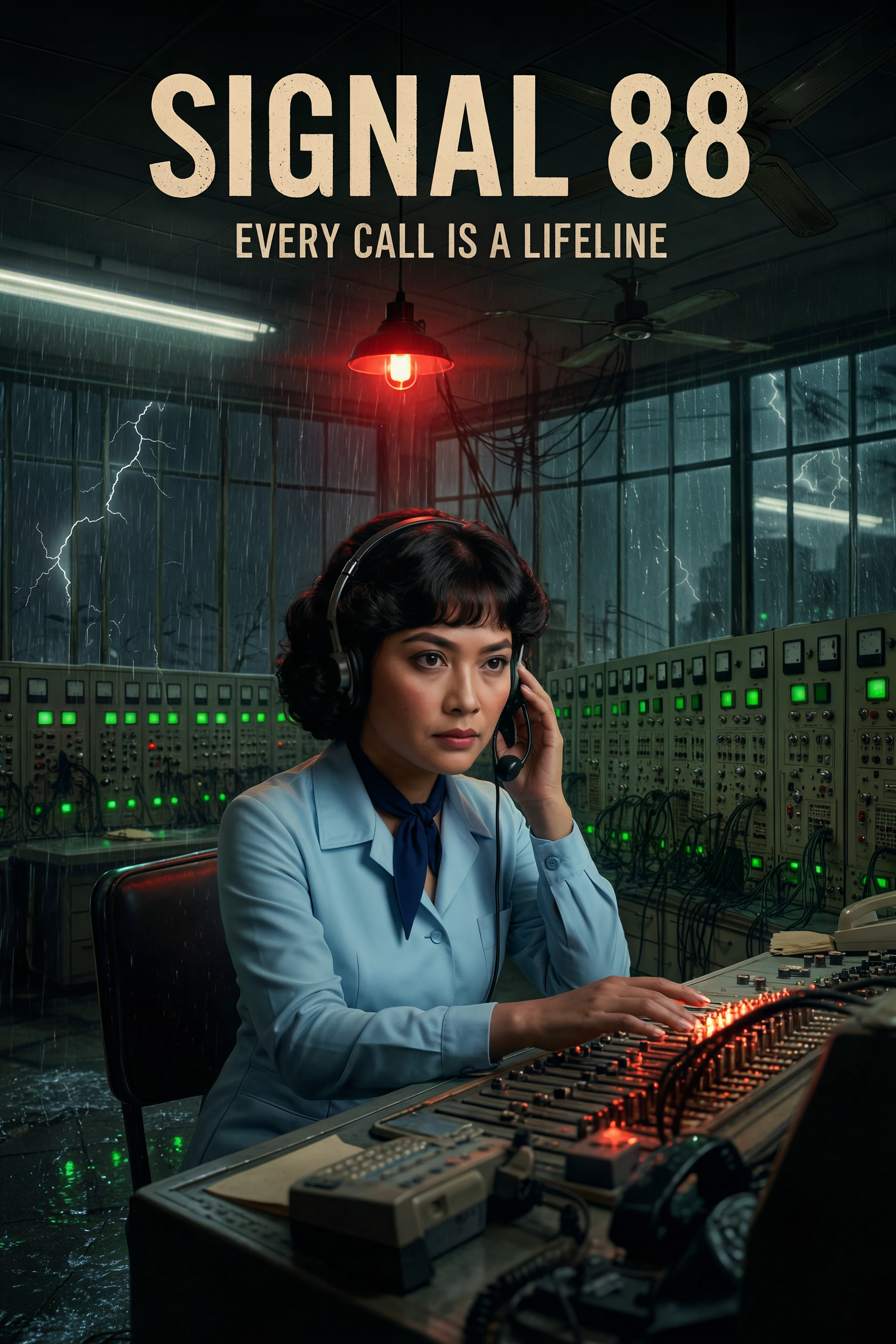
Create finished vertical 2K streaming-series poster key art for a fictional Filipino period disaster thriller titled “SIGNAL 88”. Use <<<image_1>>> as the exact visual reference for the lead operator’s face, hairstyle, uniform and headset; preserve her recognizable facial structure and natural Filipino skin tone. Use <<<image_2>>> as the complementary reference for the historically credible 1980s analog telephone exchange, including switchboard construction, patch cords, indicator lamps and institutional materials. Central composition: the operator sits alone at the switchboard during the height of a Manila typhoon in 1988, framed from mid-torso upward and looking just past camera with controlled fear and fierce concentration. One hand presses her headset earpiece while the other reaches toward a glowing patch connection. Behind her, regimented rows of switchboard lights recede into darkness like a city grid. Wind-driven rain lashes tall wired-glass windows; water creeps across the floor and reflects green status lamps. A single emergency-red lamp burns above her while cold cyan storm light cuts across one side of her face. Subtle lightning reveals dense cables and ceiling fans in the background. The danger must feel immediate but plausible, with no supernatural imagery. Art direction: premium Southeast Asian prestige television campaign, tense human-scale disaster drama, cinematic photographic realism with restrained graphic design. Deep petrol blue, oxidized green, emergency red and nicotine-cream palette; humid air, practical fluorescent light, rain haze, realistic wet fabric, glass and aged metal. Strong tonal hierarchy and generous negative space in the upper third. Slight analog 35mm grain and period color response, but crisp contemporary finishing. Avoid action-movie explosions, disaster spectacle, collage layouts, floating heads, weapons, futuristic equipment and cyberpunk styling. Typography is integral to the finished poster. At the upper center, set the exact title “SIGNAL 88” in large condensed uppercase sans-serif lettering, clean and sharply legible, warm off-white with subtle weathered ink texture. Directly below it, smaller uppercase text: “EVERY CALL IS A LIFELINE”. Keep all lettering level, correctly spelled and unobstructed. No other copy, credits, logos, platform marks, borders, mockup context or interface elements. Deliver one complete standalone portrait poster, not a poster photographed on a wall.