Seedream 4.5
Request
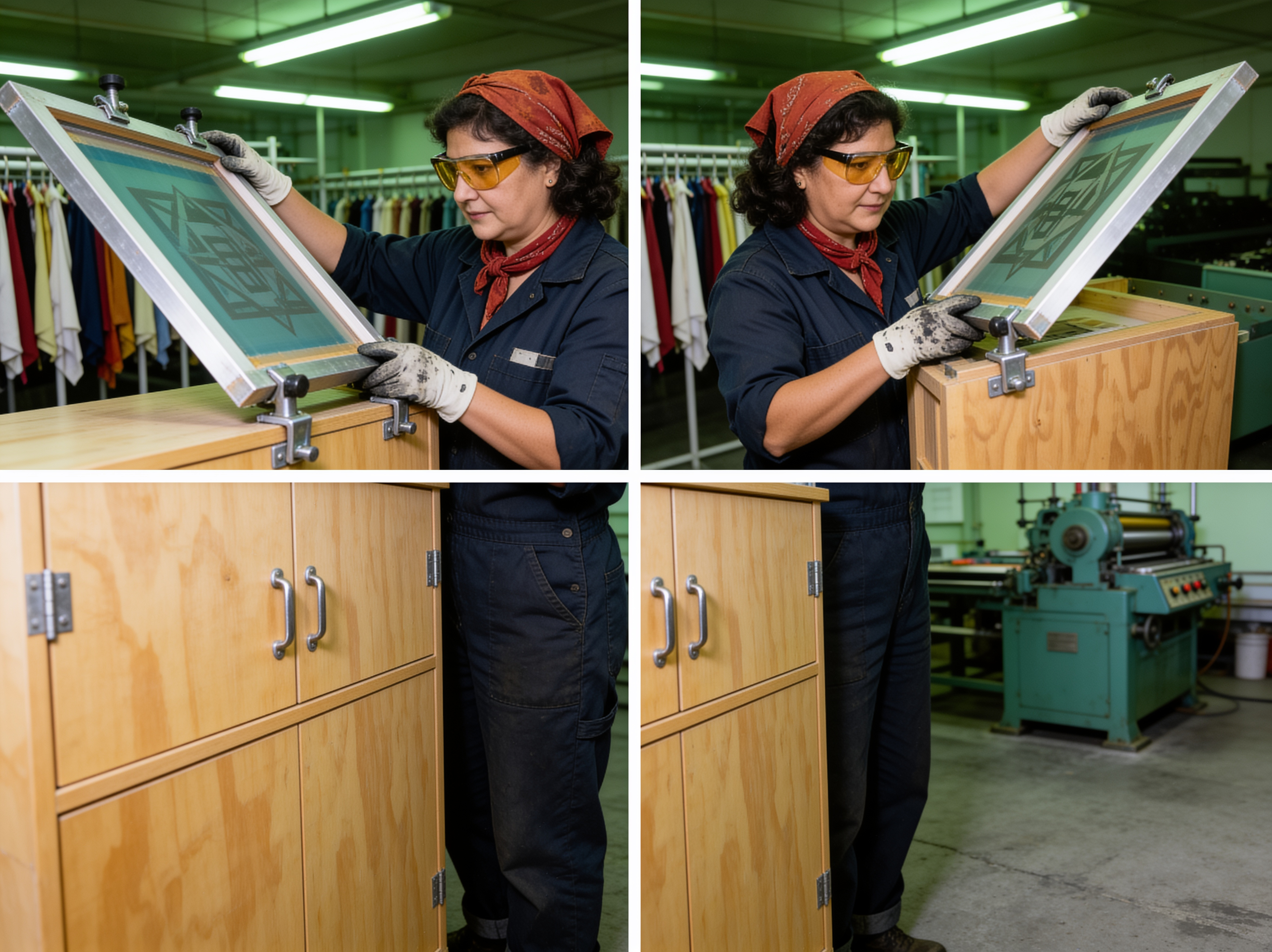
Using both references, produce exactly four separate, sequentially generated 4:3 archival photographs—not a collage, grid, contact sheet, restoration comparison, or modern reenactment. Faithfully reconstruct the four exposures shown in the contact sheet while using the enlargement to preserve the technician's exact facial features, kerchief, safety glasses, coveralls, hands, tools, cabinet proportions, machinery, and factory environment. The action must progress clearly: image 1, she aligns and clamps the hinged silk screen over the bare plywood cabinet side; image 2, she pours burnt-orange ink along the upper edge; image 3, she draws the squeegee firmly across the screen; image 4, she lifts the screen and inspects the newly printed geometric motif. Maintain consistent camera height, documentary framing, worker identity, cabinet, print station, background racks, and overhead fluorescent lighting across all four images. Repair tears, creases, scratches, dust, fading, silvering, and missing emulsion with natural photographic detail. Apply restrained, historically plausible 1976 colorization: navy work coveralls, rust-red kerchief, amber safety glasses, warm birch plywood, burnt-orange ink, muted avocado industrial machinery, gray concrete floor, and slightly green fluorescent illumination. Preserve subtle silver-gelatin grain, modest lens softness, realistic skin texture, period materials, and the candid industrial-documentary mood. Do not beautify, modernize, add logos, invent readable signage, or erase all archival texture. Each result must look like an individually restored museum scan from the same original photographic sequence.
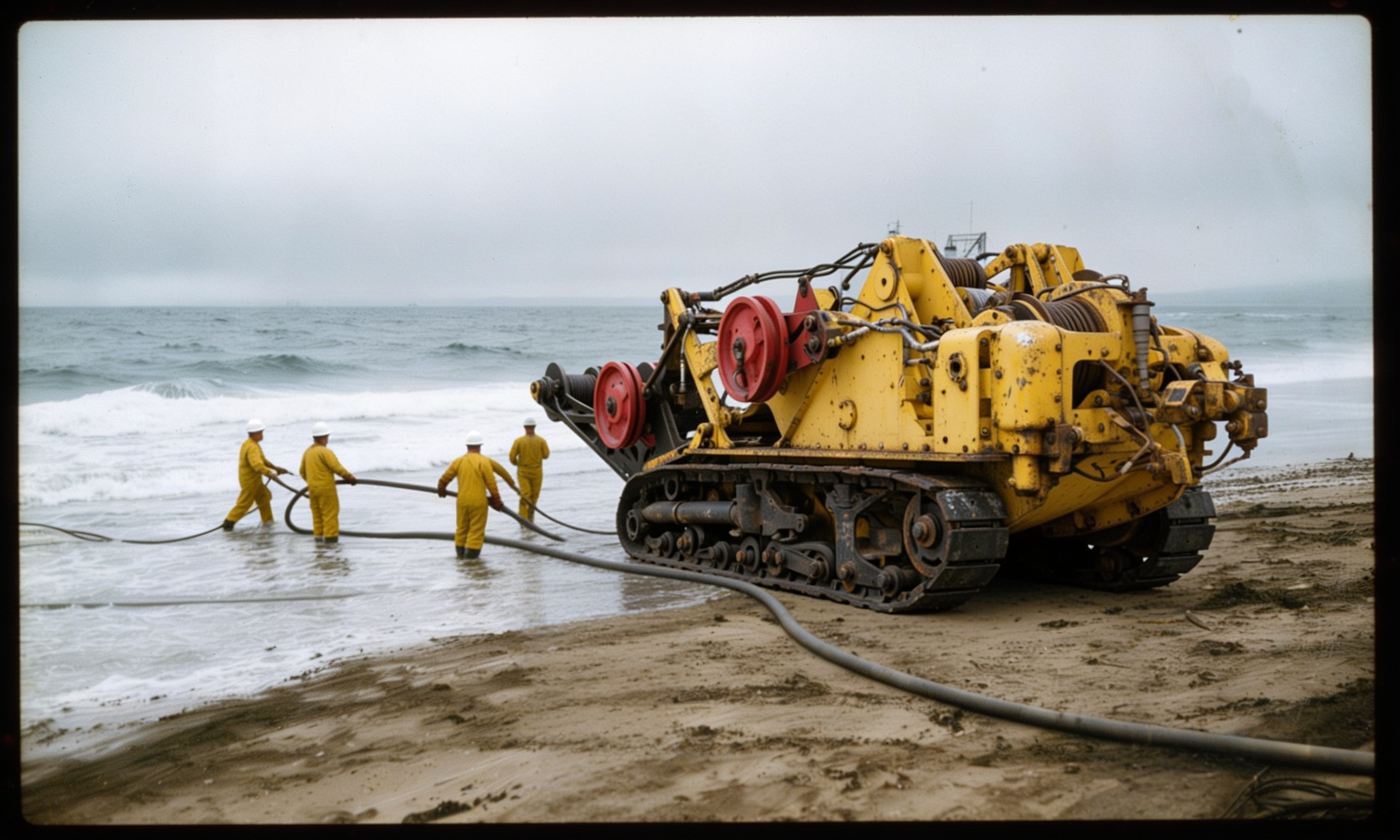
Create a meticulous museum-archive restoration and historically credible colorization. Use reference image 1 as the absolute source for composition, people, facial identity, poses, cable route, beach geography, ship placement, perspective, and documentary character. Repair the torn print, reconstruct the missing lower-right emulsion, remove water stains, creases, dust, scratches, fading, and chemical damage while retaining fine natural film grain and the honest texture of a 1963 press photograph. Use reference image 2 to accurately restore the tracked cable plough: preserve its exact proportions and mechanical construction, with safety-yellow painted bodywork, dark steel tracks, red rollers, winch, hydraulic lines, rivets, wear, and salt-weathered surfaces. Use reference image 3 as the authoritative color reference for the workers, oilskins, knitwear, trousers, gloves, hard hats, marker buoys, skin tones, Atlantic water, and muted Newfoundland coastal palette. Color should feel restrained and photochemically authentic, like a carefully preserved early-1960s Kodachrome print rather than modern digital grading. Recover believable detail in faces without beautifying or changing anyone. Preserve the overcast light, cold wind, wet sand, sea mist, and serious working atmosphere. Do not add, remove, relocate, or redesign any person, machine, cable, vessel, or landscape element. Deliver one seamless restored landscape photograph with natural edge-to-edge framing, no borders, captions, labels, museum display, or added text.
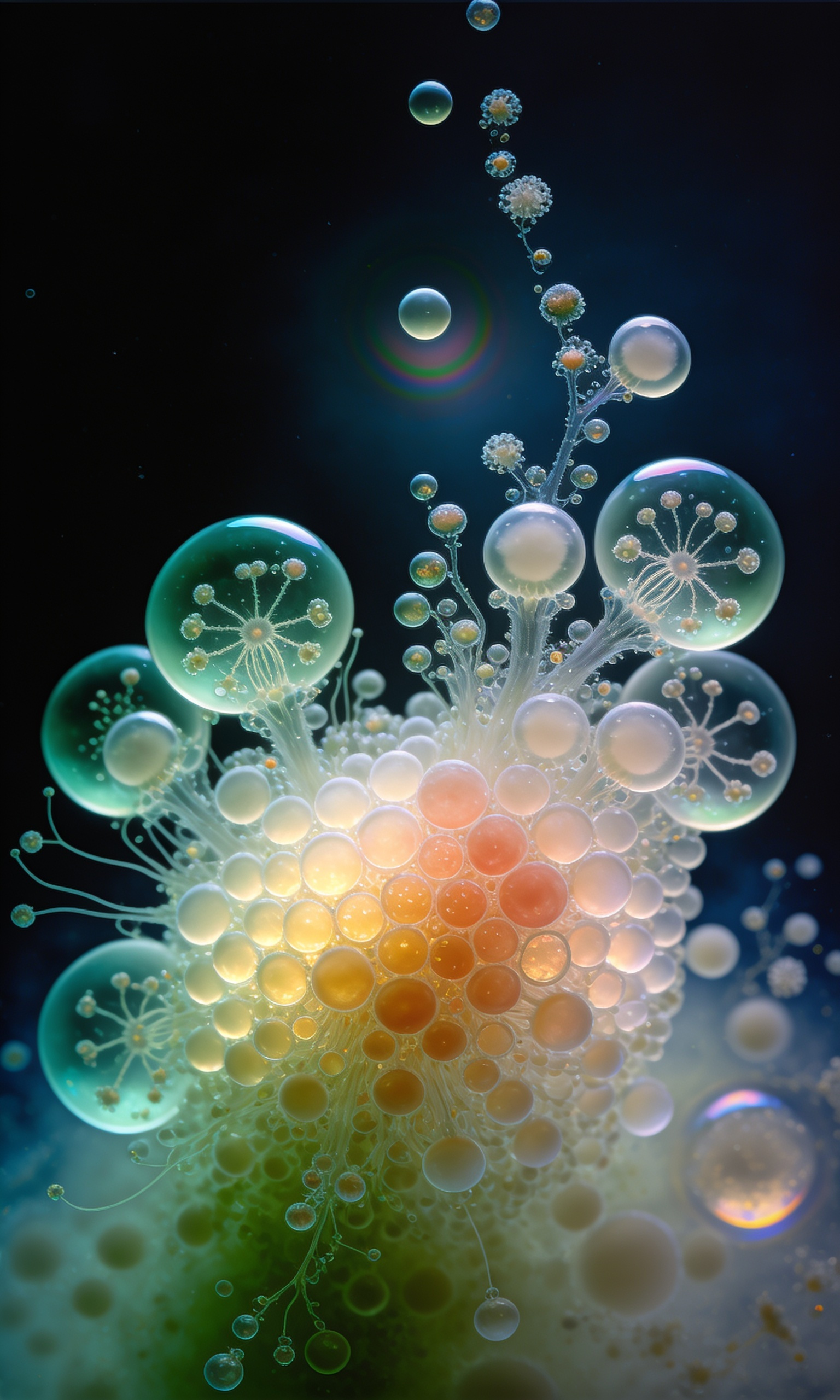
Create a finished portrait-format fine-art print inspired by a microscopic precision-fermentation culture, designed for the sophisticated lobby of a biotechnology laboratory. An edge-to-edge dark-field composition of hundreds of translucent circular cells, delicate branching membranes, tiny nutrient vesicles, and threadlike microbial structures suspended in deep space. Build a graceful vertical flow: a dense glowing colony near the lower third gradually disperses upward into sparse individual organisms, leaving calm negative space around the upper center. Render the biology with convincing microscopic detail but compose it like abstract contemporary art rather than a textbook diagram. Luminous celadon green, pale saffron, muted coral, and opalescent ivory forms against an inky blue-black ground; subtle halos, diffraction colors, glassy depth, restrained bloom, and crisp cellular edges. Elegant, meditative, scientifically informed, premium gallery aesthetic, richly detailed at close viewing distance, balanced for a tall 3:5 art print. No labels, no typography, no border, no frame, no room mockup, no people, no laboratory equipment.
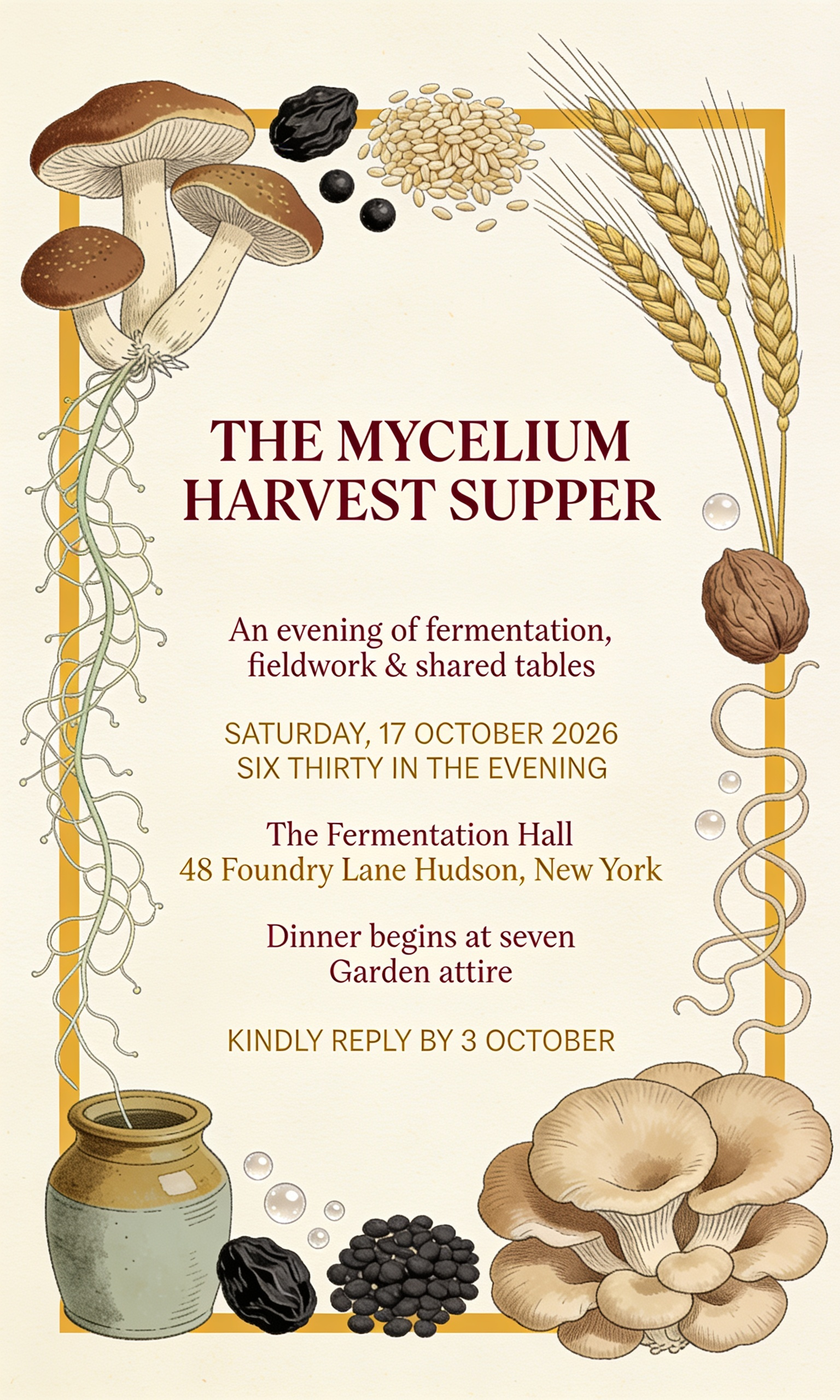
Create a finished, flat portrait invitation design for an autumn donor dinner hosted by an experimental fermentation research collective. Sophisticated editorial art direction blending nineteenth-century natural-history engraving with contemporary artisan letterpress. Use a warm bone-paper background with visible cotton fibers, deep oxblood typography, saffron accents, muted mushroom brown, and touches of dusty sage. Frame the invitation with an intricate asymmetrical botanical border of oyster mushrooms, barley heads, koji rice grains, black walnuts, tiny fermentation bubbles, ceramic crocks, and curling mycelium threads. The specimens should feel scientifically observed yet abundant and celebratory, rendered with fine engraved lines and selective flat color. Place one large oyster mushroom cluster at the lower right and delicate mycelium filaments climbing toward the upper left, leaving a generous calm central field for typography. Elegant, intimate, cultivated mood; tactile print character; crisp details; balanced negative space; restrained decorative ornament; premium independent cultural-institution aesthetic. Set the following wording exactly, with no additional text: THE MYCELIUM HARVEST SUPPER An evening of fermentation, fieldwork & shared tables SATURDAY, 17 OCTOBER 2026 SIX THIRTY IN THE EVENING The Fermentation Hall 48 Foundry Lane Hudson, New York Dinner begins at seven Garden attire KINDLY REPLY BY 3 OCTOBER Use a refined high-contrast serif in uppercase for the title, slightly condensed and centered. Set supporting copy in a highly legible classic serif with generous line spacing. Use small caps and subtle saffron rules for the date, venue, and reply line. Maintain impeccable spelling, clean hierarchy, and precise alignment. This is the standalone front of a professionally printed invitation, edge-to-edge artwork, not a card mockup, not shown in a hand, and not placed on a table.