MiniMax H3 Image Highspeed
Request
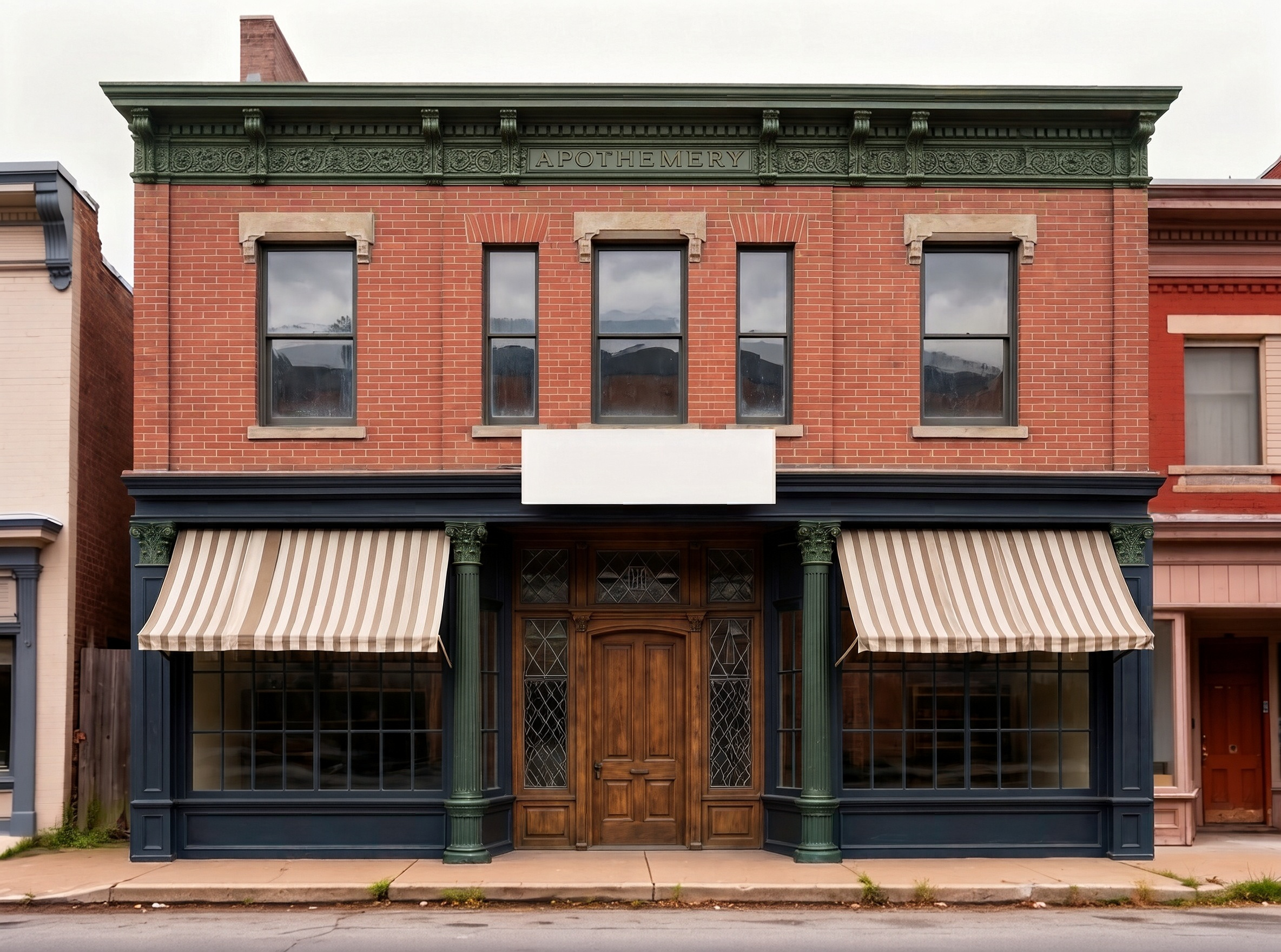
Create a finished 2K landscape architectural restoration visualization for a historic-preservation architect. Use image 1 as the primary contemporary site photograph and preserve its exact camera position, perspective, crop, facade proportions, roofline, brick massing, three-window arrangement, party-wall relationships, sidewalk geometry, neighboring building fragments, and soft overcast lighting unchanged. Use image 2 strictly as the historical evidence reference for the restoration design: accurately reconstruct its original cast-iron storefront columns, divided-light display windows, glazed recessed entrance, prism-glass transom, pressed-metal cornice, traditional wood trim profiles, masonry joint character, and striped canvas awning on the building in image 1. Do not copy image 2's monochrome treatment, photographic damage, people, street objects, or old camera distortion. Show the facade as carefully restored rather than newly built: gently cleaned warm red brick with subtle age variation, compatible buff lime-mortar repointing, repaired dark bronze-green painted cast iron, deep charcoal wood storefront framing, clear glazing with faint reflections, slightly irregular historic glass, and a muted cream-and-umber awning. Retain believable minor patina and hand-crafted irregularities. Remove plywood, temporary patches, loose cables, and obvious modern deterioration while preserving sound historic fabric. Keep the horizontal signboard blank, with no invented business name, labels, captions, logos, border, split-screen treatment, presentation-board graphics, or UI. Photorealistic preservation rendering, measured and credible material detailing, restrained natural color, diffuse cloudy daylight, documentary architectural photography, sharp facade detail without exaggerated HDR, no people, no cars, no construction equipment.
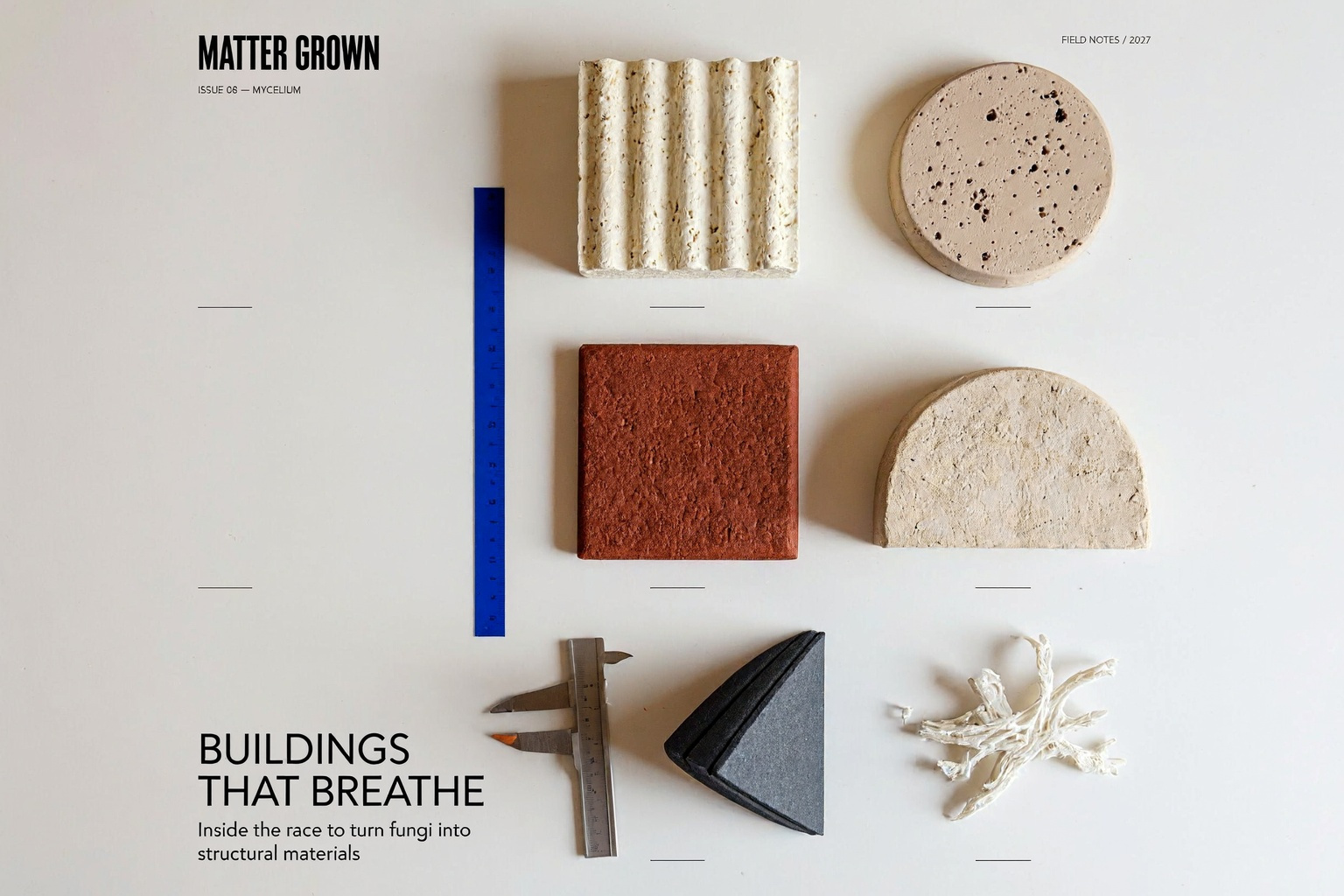
Create a finished landscape digital magazine cover about mycelium-based architecture, shown straight-on as the artwork itself with no mockup, device, border, or surrounding scene. Editorial layout: place the large masthead "MATTER GROWN" across the upper left, set in bold condensed uppercase sans serif letters; directly below it, place the smaller issue line "ISSUE 08 — MYCELIUM". Use the main headline "BUILDINGS THAT BREATHE" in two large stacked lines at the lower left. Beneath it, add the small deck "Inside the race to turn fungi into structural materials". Place "FIELD NOTES / 2027" in tiny uppercase type at the upper right. Render only these exact words, with clean spelling and no additional text. The cover image is a precise overhead editorial still life on a warm off-white laboratory table. Arrange exactly six mycelium construction samples in an orderly loose grid across the center and right side: one tall cream ribbed brick at top center, one circular porous tile at top right, one rust-red compressed panel at middle center, one pale beige arch-shaped block at middle right, one charcoal-gray acoustic wedge at bottom center, and one small branching white fungal composite at bottom right. Keep the lower-left area visually quiet behind the headline. Add a thin cobalt-blue ruler, a stainless steel caliper, and several restrained specimen-label lines without readable microtext. The materials should look physically credible, tactile, fibrous, dry, and engineered rather than like food. Art direction: contemporary European architecture journal, rigorous Swiss editorial grid softened by organic materials. Palette of bone white, mushroom beige, rust, charcoal, and vivid cobalt blue. Crisp top-down studio photography, soft directional daylight from upper left, subtle contact shadows, fine surface detail, premium matte-print character, generous negative space, intelligent and optimistic mood. Strong hierarchy and highly legible typography, balanced for a 3:2 landscape cover.
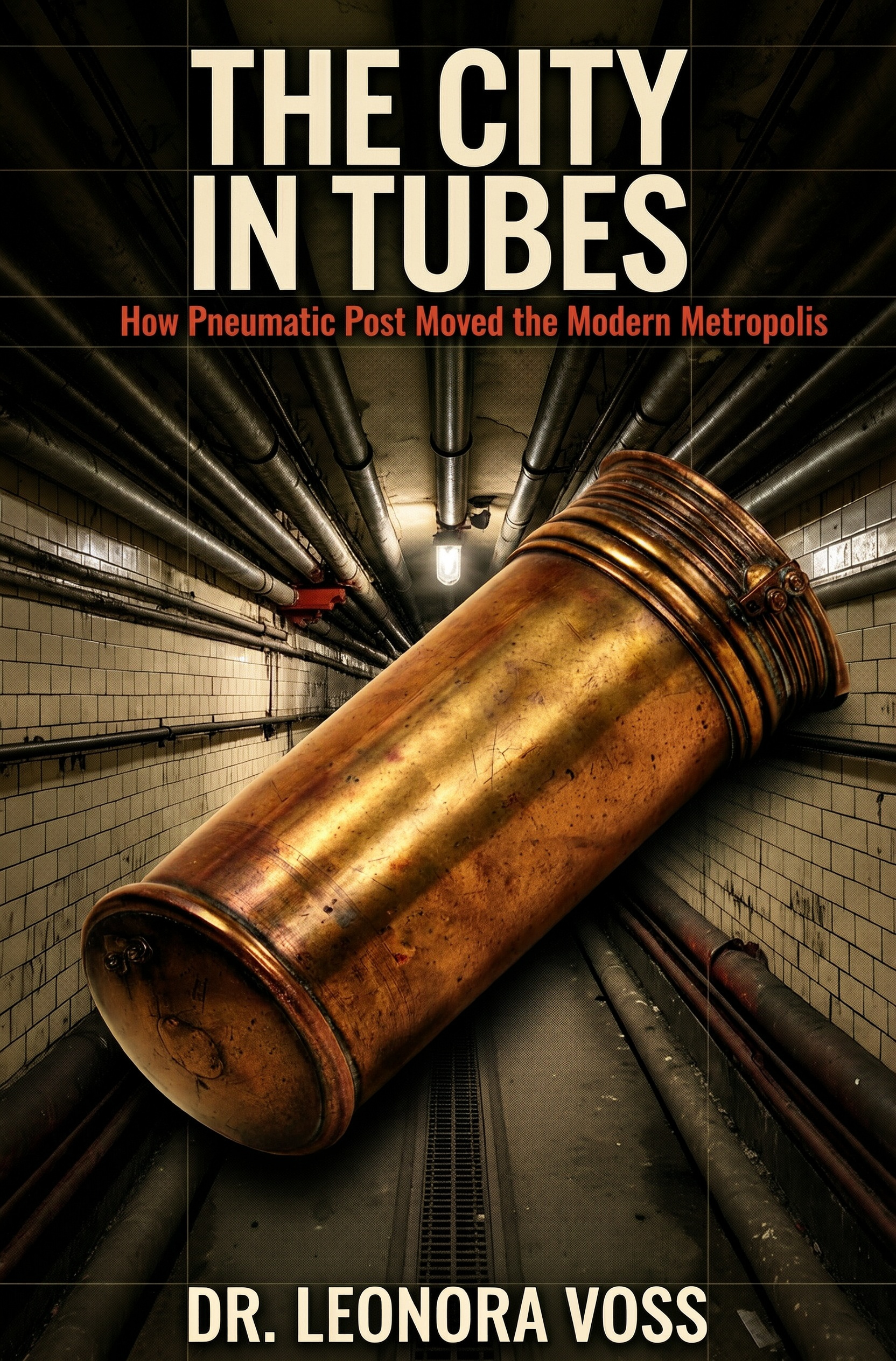
Create a finished portrait-format front cover for an authoritative university-press history book about the forgotten pneumatic postal networks beneath modern cities. Use both supplied references together. Image 1 provides the hero object: preserve the pneumatic mail capsule’s exact cylindrical silhouette, proportions, ribbed cap construction, scratches, dents, tarnished brass patina and dark seams unchanged. Do not redesign, simplify, duplicate or add branding to the capsule. Enlarge it into a bold diagonal foreground element rising from lower left toward upper right, photographed with convincing dimensionality. Image 2 provides the setting, perspective and color language: preserve the tunnel’s recognizable structural layout, central vanishing point, tiled walls, parallel pipe positions, maintenance walkway, aged cream, soot black, rust red and tungsten amber palette unchanged. Integrate the capsule naturally over this setting while retaining the tunnel architecture. Art direction: sophisticated archival photomontage combining 1930s transport graphics with disciplined contemporary Swiss editorial design. Intelligent, kinetic and historical rather than nostalgic or steampunk. Use hard geometric cropping, subtle halftone grain, fine registration texture and restrained paper tactility while keeping the capsule and tunnel photographically credible. Strong depth leads toward the distant utility light. High contrast with generous controlled negative space in the upper third for typography. Set clear, correctly spelled cover typography as an intentional part of the design. Large condensed sans-serif uppercase title on separate lines: “THE CITY” then “IN TUBES”. Add the smaller subtitle: “How Pneumatic Post Moved the Modern Metropolis”. Place the author name at the bottom: “DR. LEONORA VOSS”. Typography should be cream and rust red with excellent hierarchy and legibility, aligned to a strict modernist grid without covering the capsule’s cap or the tunnel vanishing point. No additional copy, badges, logos or decorative pseudo-writing. Deliver only the flat, edge-to-edge front cover artwork, not a physical book mockup, not a dust jacket spread, no spine, no back cover, no hands, no shelves and no surrounding environment.
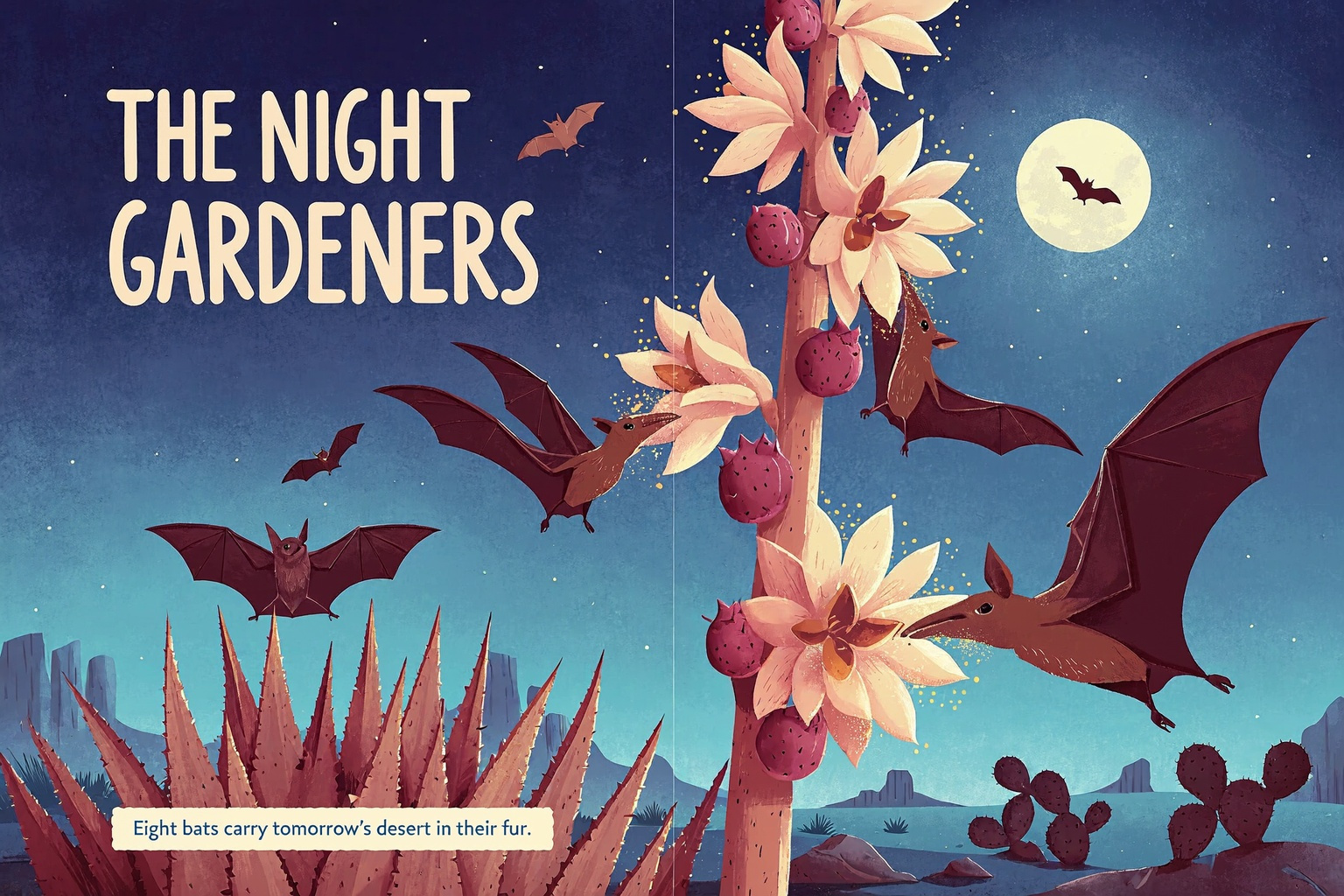
Create a finished landscape children’s nonfiction picture-book spread about lesser long-nosed bats pollinating agave flowers at night. Design it as one continuous 3:2 illustration spanning two facing pages, with a subtle vertical safe gutter through the center and no book mockup, page edges, interface, or border. LAYOUT AND CONTENT: Place the headline “THE NIGHT GARDENERS” in the upper-left quadrant, arranged on two lines in very large, bold, hand-cut uppercase lettering. Place the sentence “Eight bats carry tomorrow’s desert in their fur.” in a small cream narration box at the lower left, set in clear, friendly dark-blue lettering. Reproduce both quoted texts exactly, with correct spelling and punctuation. Include no other words, letters, labels, numbers, signatures, or logos. Show exactly eight bats, all clearly separate and countable: one large foreground bat at lower right approaching a luminous agave bloom; two medium bats feeding from separate flower clusters around the central agave stalk; one medium bat banking above the left-page agave rosette; three small flying bats spaced across the upper sky; and one small bat silhouetted against the full moon at upper right. Do not add any additional bats, partial bats, or bat-like shapes. The central subject is a towering flowering agave with pale blossoms crossing the spread while keeping its main stalk slightly right of the gutter. Surround it with low desert plants, prickly pear, rocks, and distant mesas. Show tiny golden pollen grains dusting the muzzles and fur of the three feeding bats, making the pollination story immediately understandable. Preserve open sky behind the title and keep all important faces and text away from the center gutter. ART DIRECTION: sophisticated cut-paper and gouache illustration for ages 6–9, with simplified geometric silhouettes, tactile deckled edges, subtle dry-brush texture, and crisp editorial composition. Limited nocturnal palette of deep indigo, moonlit turquoise, dusty coral, magenta cactus fruit, warm cream, and pollen gold. Gentle moonlight creates luminous flower tips and readable bat silhouettes. Curious, calm, and wondrous rather than spooky; scientifically grounded anatomy with charming expressive poses. Print-ready picture-book quality, strong visual hierarchy, clean typography, no photorealism, no gradients that look digital, no extra decorative text.