Qwen-Image
Request
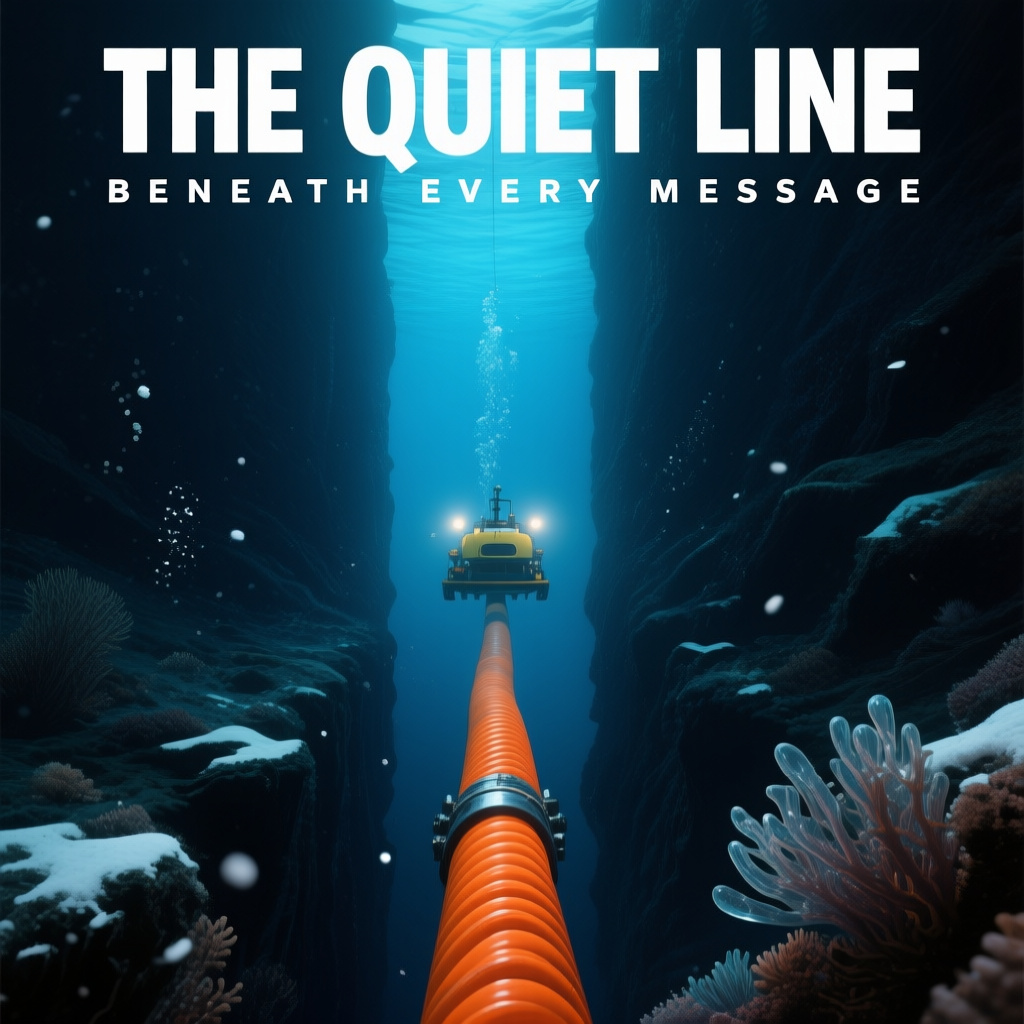
Create the finished 1:1 square expansion of cinematic key art for a premium documentary about the subsea fiber-optic cables carrying global communications. The composition should feel seamlessly outpainted from an originally narrow vertical underwater image: preserve a strong central corridor containing a bright orange armored cable descending into a midnight-blue abyss, then extend the scene naturally to both sides with a vast dark seafloor, drifting marine snow, faint ridges of basalt, delicate glass sponges, and the distant work lights of a compact inspection ROV. A precise pool of cold cyan light reveals the cable and suspended particles while the outer edges fall into rich indigo-black water. Add restrained analog film grain, subtle halation around the ROV lamps, crisp documentary realism, and an elegant high-contrast editorial finish. Use the expanded side areas to create scale and negative space rather than adding competing subjects. Place the exact title “THE QUIET LINE” in large, clean, condensed white capitals across the upper third, perfectly spelled and sharply typeset. Directly beneath it, render the exact tagline “BENEATH EVERY MESSAGE” in smaller widely tracked white capitals. Keep all lettering level, legible, undistorted, and unobstructed. No other words, logos, credits, borders, interface elements, or mockup framing. Finished standalone documentary campaign artwork, tense, intelligent, technically credible, visually balanced for a square social release.
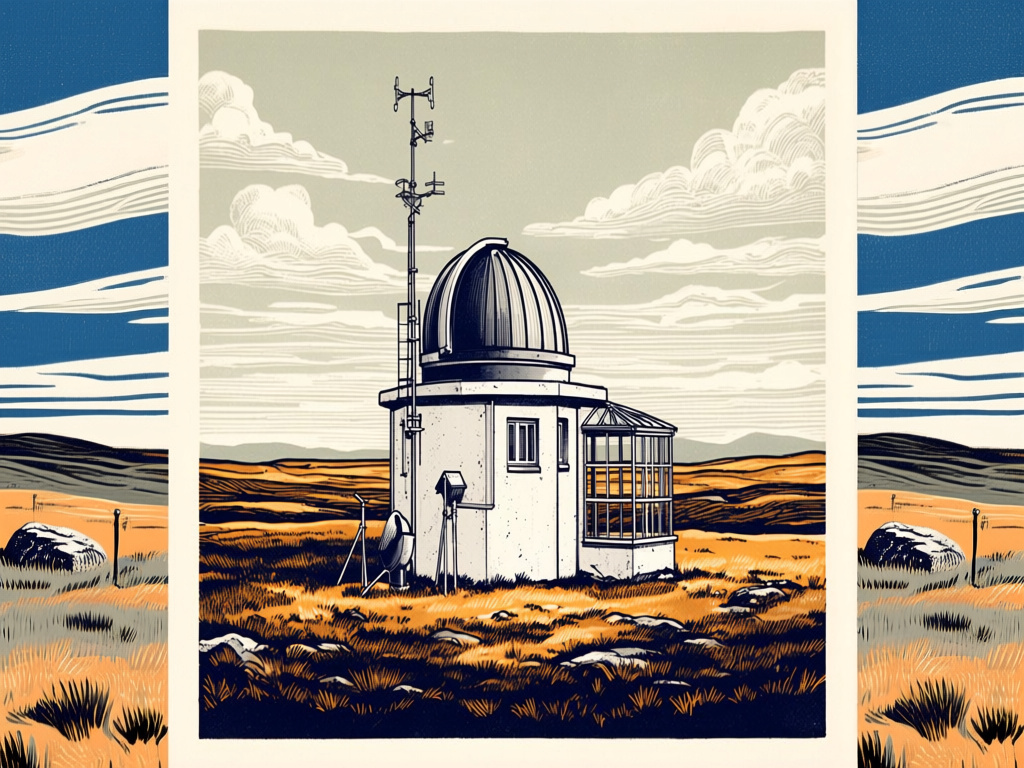
Create a finished 1024x768 landscape illustration for print-on-demand wall art and desktop wallpaper by extending the supplied central image naturally beyond both horizontal edges. Preserve the meteorological observatory, its proportions and its central placement. Reveal the full breadth of a remote highland weather station: a low white 1960s concrete observatory with a shallow instrument dome, slender anemometer mast, rain gauge and Stevenson screen, surrounded by windswept grassland. Continue the gently undulating plateau across the left and right sides at the same horizon height, perspective and subject scale. Add sparse survey stakes, small basalt rocks and rhythmic clumps of grass in the expanded foreground, with no large new focal subject. Extend the long layered cloud bands seamlessly across the entire sky and keep the wind direction consistent in every grass tuft and cloud shape. Bold hand-pulled linocut and reduction woodcut aesthetic, visible carved gouges, irregular ink coverage, tactile ivory paper grain, simplified architectural geometry and crisp graphic silhouettes. Limited palette of deep indigo sky, warm ochre grass, muted sage accents, charcoal details and unprinted ivory highlights. Quiet, bracing, contemplative mood; balanced negative space; refined contemporary editorial printmaking; cohesive edge-to-edge composition suitable for a wide art print. Consistent flat directional light from the upper left, consistent shadows, textures and line weight throughout. No lettering, numbers, logos, frame, mat, mockup, people or interface elements.
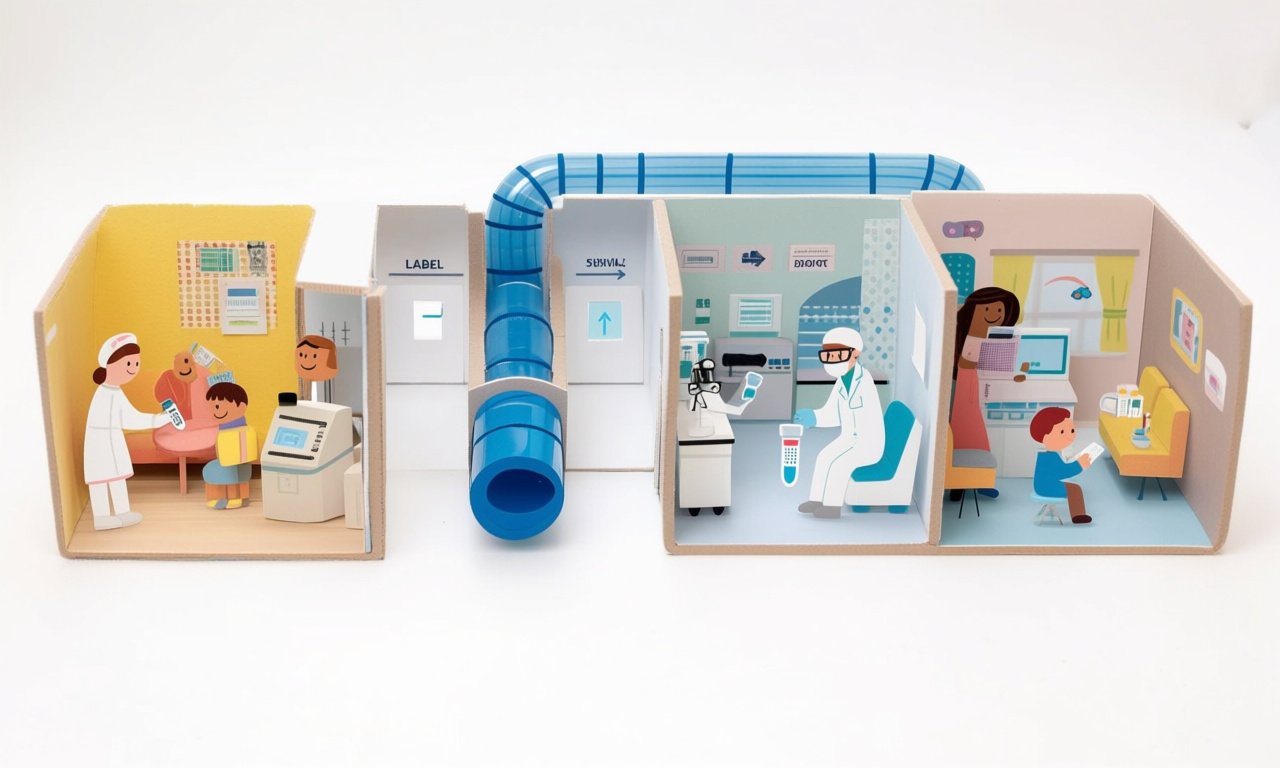
Transform the supplied photographic hospital model into a finished educational illustration for a pediatric hospital waiting area, aimed at children ages 7–11. Preserve the seed image’s recognizable four-room left-to-right cutaway layout, the placement of the people and equipment, and especially the continuous pneumatic-tube route. Replace the realistic miniature appearance with warm layered cut-paper collage, opaque gouache textures, rounded geometric shapes, subtle screen-printed dots, and crisp editorial diagram design. At the top, set the exact title: “WHERE DOES MY SAMPLE GO?” in large, friendly, highly legible navy uppercase lettering. Organize the journey into four clearly separated but connected stages matching the source composition. Stage one shows a calm child seated beside a reassuring nurse while a small capped sample tube receives a barcode label. Stage two shows the sealed sample carrier entering the transparent blue pneumatic tube and moving through the corridor, with simple directional arrows. Stage three shows a diverse laboratory scientist safely handling the capped tube beside a compact analyzer, wearing gloves and a lab coat. Stage four shows a clinician sharing the result with the child and parent in a bright consultation room. Keep all medical actions accurate, gentle, clean, and non-frightening; no needle, exposed blood, distress, or invasive procedure. Add these exact short labels and captions, with no other text: “1 LABEL” “A barcode keeps it matched to you.” “2 SEND” “A sealed carrier rides the tube.” “3 TEST” “Lab scientists check the sample.” “4 RESULTS” “Your care team gets the answer.” Use cobalt blue for the tube journey, with coral, apricot, mint, mustard yellow, warm cream, and deep navy throughout the rooms. Make the blue route visually continuous and easy for a child to follow from left to right. Include small friendly visual motifs such as stars, dots, and arrows only where they clarify the process. Balanced 1280x768 landscape layout, generous safe margins, accessible visual hierarchy, diverse characters with natural proportions and expressive but understated faces. Produce the standalone flat artwork itself, not a framed sign, room photograph, website, app interface, or presentation mockup. All specified lettering must be correctly spelled and clearly readable.
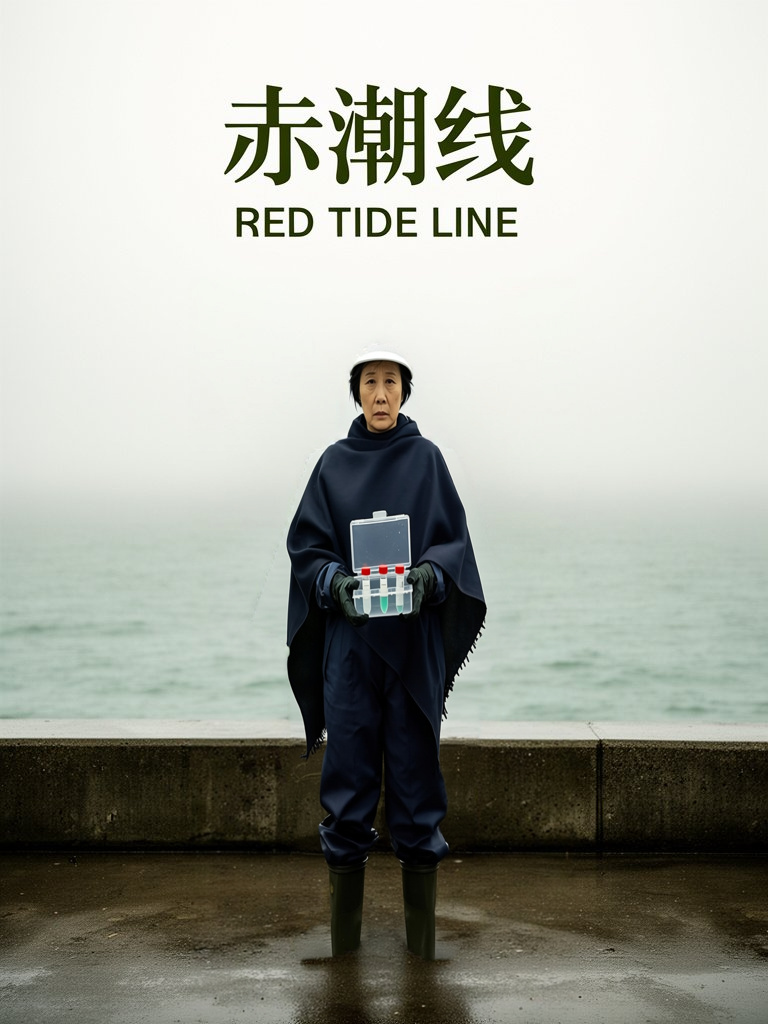
Edit the masked foreground subject only and substantially replace the entire person while preserving the surrounding poster exactly. Transform the generic poncho-clad figure into the lead character: a Chinese woman in her late forties, a senior marine disease investigator, standing confidently and looking directly into the camera. Give her a weathered, intelligent face, short windblown black hair threaded with gray, and a calm but guarded expression. She wears a practical cadmium-orange flotation work suit with reflective strips, dark waterproof gloves, and sea-stained rubber boots. In one hand she holds a compact transparent evidence case containing three sealed seawater sample vials; the case must remain within the masked silhouette. Add convincing damp fabric, salt residue, subtle fog moisture, and cool overcast light so she integrates naturally into the existing seawall scene. Maintain the original stance, scale, grounding, shadow direction, and full-body silhouette. Preserve every unmasked element without alteration: the pale fog, flat gray-green sea, wet concrete seawall, negative space, restrained chalk-white and kelp-green color grade, and the exact campaign typography. Keep the large Chinese title “赤潮线” at the top and the smaller English title “RED TIDE LINE” directly beneath it perfectly legible, correctly spelled, sharply typeset, and unchanged. The final result is polished prestige eco-thriller key art for a six-part streaming series, tense, intelligent, realistic, minimal, and ready for release.